(440) 352-3434
Blog
Custom Foam Validation: The Science Behind Total Protection
When protecting mission-critical assets, whether sensitive military electronics, delicate medical imaging optics, or high-value aerospace components, engineering teams routinely invest heavily in rugged, high-performance outer cases (such as Pelican or Nanuk). These heavy-duty outer shells provide essential defense against moisture, dust, and crushing external loads. However, relying on a robust exterior shell addresses only half of the transport equation.
The true determinant of equipment survival during transit is the internal cushioning system. Even the most resilient outer enclosure cannot prevent delicate internal circuitry from absorbing destructive kinetic energy if the foam interior fails to dampen acceleration forces. True equipment safety is achieved when precision-engineered foam and outer shells function as a unified dynamic barrier. Achieving this level of reliability requires moving past intuition and adopting precise engineering validation.
The Hidden Risk: The Failure of Stock and Intuitive Foam
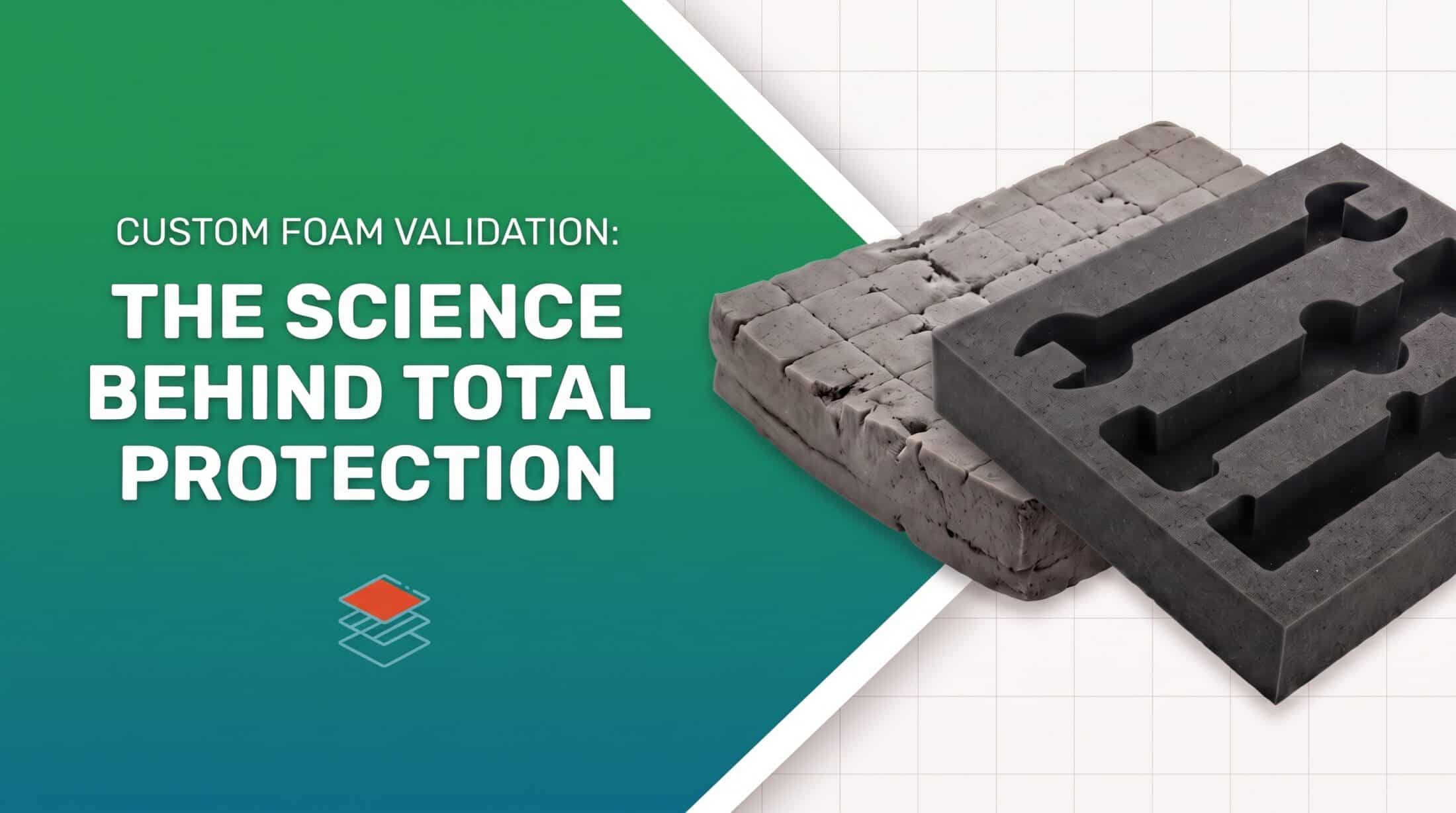
In many engineering and shipping departments, pick-n-pluck or generic stock foam inserts remain a tempting shortcut. On the surface, pluck foam seems convenient, allowing operators to hand-fit equipment into pre-scored grid cubes. However, from a structural and material dynamics perspective, low-density stock foam represents a major risk for high-value equipment.
Stock foam inserts suffer from key weaknesses:
- Structural Degradation & Tear Propagation: Pre-cut perforations dramatically reduce the shear strength of the material. Repeated loading and unloading cause micro-tears along the grid lines, leading to rapid material fatigue, sagging, and eventual total structural collapse.
- Inadequate Cushioning and Bottoming Out: Unvalidated generic foam density frequently fails under drop conditions. If the foam density is too soft, heavy equipment forces the material to compress fully upon impact; an event known as “bottoming out”. When this occurs, kinetic energy is transmitted directly into the payload, yielding destructive peak deceleration forces.
- Over-Cushioning and Excessive Energy Transfer: Conversely, using excessively rigid foam for lightweight, sensitive devices yields minimal deflection upon impact. The rigid material acts like a solid body, transmitting sharp impact shocks directly into fragile assemblies.
The Superior Solution: Engineering-Grade Custom Cushioning
Transitioning to custom-fabricated foam inserts eliminates the guesswork inherent in stock solutions. Instead of forcing expensive instruments into generic cutouts, precision custom foam inserts are designed specifically around your equipment’s unique geometry, center of gravity, weight distribution, and fragility threshold.
Through advanced packaging engineering services, every custom insert is developed as an engineered protective system. Custom fabrication delivers exact spatial clearance, optimized load-bearing surfaces, and tailored energy absorption profiles.
Material Science and Design Fundamentals
Selecting the appropriate polymer matrix is the foundation of effective packaging design. Different foam formulations offer distinct mechanical responses under compression and impact:
- Polyethylene (PE): A highly resilient, closed-cell foam characterized by excellent tensile strength and load-bearing capacity. Its closed-cell geometry prevents fluid absorption and chemical degradation, making it ideal for heavier industrial tools, calibration units, and mechanical assemblies.
- Cross-Linked Polyethylene (XLPE): Features an ultra-smooth, fine-celled structure achieved through chemical or physical cross-linking of polymer chains. XLPE provides superior aesthetic appeal, exceptional tear resistance, and a non-abrasive surface that prevents scratching delicate finished surfaces or optical coatings.
- Anti-Static & Dissipative Foams: Formulated with conductive additives to prevent triboelectric charge generation, shielding sensitive microelectronics from Electrostatic Discharge (ESD) damage during transit.
Standardized ISTA Packaging Testing and Drop Testing
Material selection and spatial design are essential, but physical testing is what validates overall performance. To confirm that a custom packaging assembly will protect high-value payloads, it must undergo empirical validation governed by recognized packaging testing standards.
The International Safe Transit Association (ISTA) establishes globally recognized testing methodologies designed to replicate the hazards of global supply chains. Implementing standard ISTA packaging testing replaces subjective evaluation with verifiable dynamic data. ISTA standards cover everything from basic container strength and localized impact testing to comprehensive transit simulations involving atmospheric conditioning, random vibration profiles, and rotational drops.
Executing the Packaging Drop Test Protocol
Central to dynamic validation is the standard packaging drop test (such as ISTA 1A or 3A procedures). During a drop test sequence, the packaged asset is mounted on a mechanical drop tower and released from predetermined heights onto a flat, non-yielding impact surface.
The test protocol evaluates impact forces across multiple drop orientations to ensure complete 360-degree protection:
- Corner drop on the most vulnerable bottom structural corner.
- Edge drops along three adjacent edges defining that corner.
- Flat face drops across all six exterior faces (Bottom, Top, Right, Left, Front, Back).
During impact, embedded triaxial accelerometers record real-time acceleration data, measuring peak shock loads transmitted through the foam structure to the payload. If the measured peak shock remains below the equipment’s maximum fragility threshold, the packaging design is empirically validated. If shock levels spike above safe boundaries, the engineering team refines the foam density, contact area, or cell geometry prior to production tool cutting.
De-Risking Transit and Total Cost of Ownership
Incorporating packaging engineering services and formal ISTA validation into your product development workflow represents a high-return investment in risk mitigation. Relying on unvalidated packaging introduces substantial financial and operational liabilities:
- Direct Financial Losses: Replacing damaged, specialized high-value equipment creates immediate repair expenses and warranty fulfillment costs.
- Operational Downtime: When critical equipment arrives inoperable at a job site or medical facility, field operations stall, creating costly project delays.
- Reputational Risk: Equipment arriving damaged damages client confidence and compromises your brand’s reputation for reliability.
By validating custom foam designs through standardized drop testing prior to mass fabrication, manufacturers shift from reactive damage control to proactive quality assurance. Pre-production validation lowers total cost of ownership, eliminates unnecessary material over-engineering, and guarantees that your product arrives ready for immediate deployment.
Next Steps for Complete Protection
A premium protective case is an essential investment, but its performance ultimately depends on the custom foam insert inside. Protecting critical, high-value assets requires a scientific approach, combining advanced material selection, precision engineering, and rigorous physical validation standards.
Don’t leave your critical assets to chance. Contact us today to discuss your project requirements, request a custom foam consultation, or schedule dynamic drop testing for your protective packaging designs.