(440) 352-3434
Blog
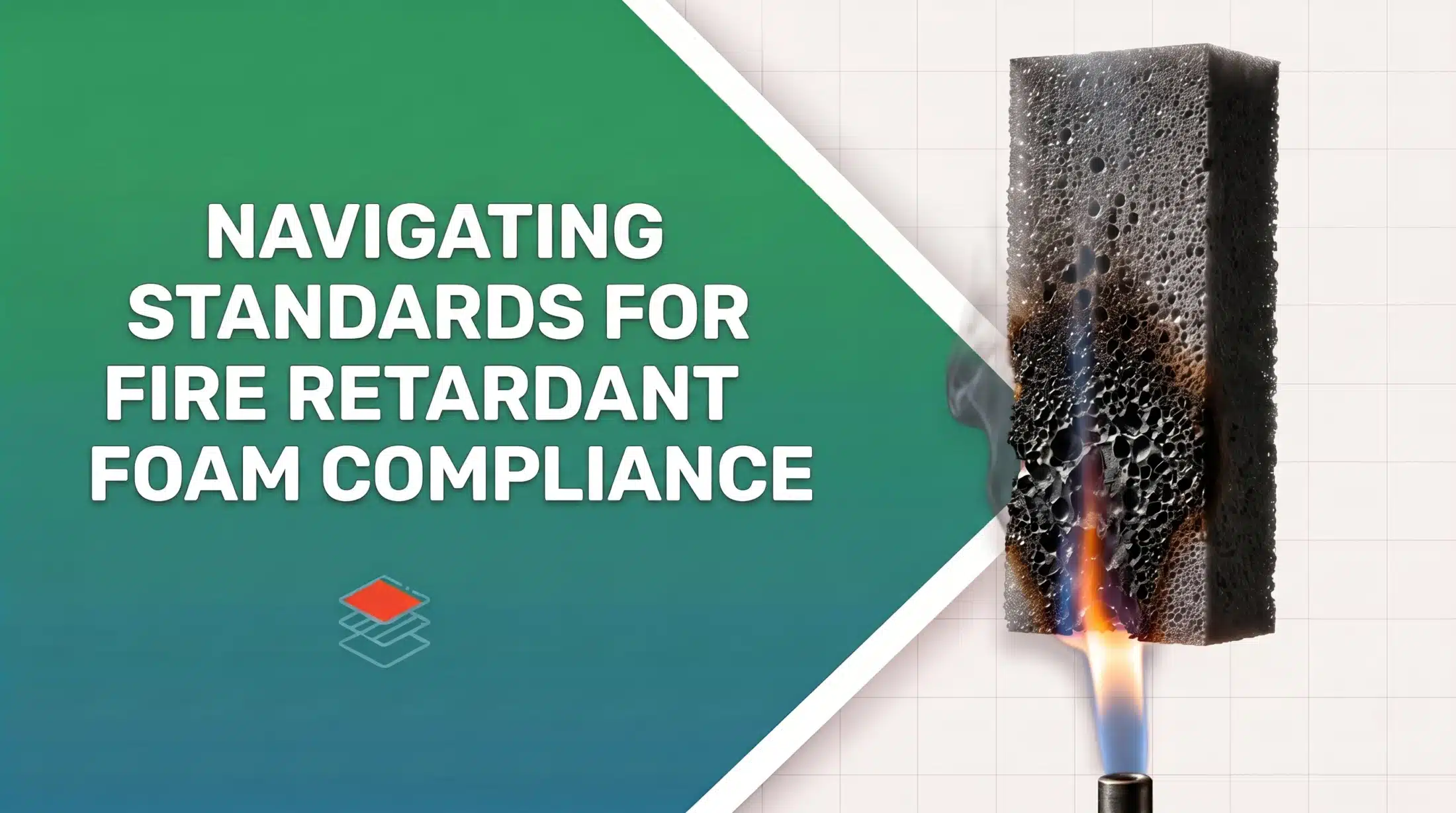
Navigating Standards for Fire Retardant Foam Compliance
KEY TAKEAWAYS
- The Shell Is Only Half the Equation: Investing in heavy-duty protective cases (like Pelican or Nanuk) only solves half of the equipment protection challenge; off-the-shelf, non-compliant foam inserts present severe flammability fuel loads, degrade under shock, and risk costly audit failures.
- Sector-Specific Flammability Frameworks: Achieving regulatory compliance requires navigating distinct testing standards, such as UL 94 V-0 for industrial electronics, FMVSS 302 for automotive interiors, and FAR 25.853 for aerospace applications, where pass/fail criteria depend on orientation, thickness, smoke density, and thermal mass.
- Engineered Material Performance: Custom fire-retardant materials like closed-cell Cross-Linked Polyethylene (XLPE) and specialized polyurethanes combine precision fabrication with intumescent or gas-phase flame retardants to guarantee self-extinguishing safety without compromising shock absorption or durability.
When specifying protective cases, electronic enclosures, or transit housings, securing high-value equipment is only part of the engineering equation. While a heavy-duty outer shell provides vital structural defense, the interior cushioning material dictates the ultimate safety of your payload. Choosing an off-the-shelf cushioning material can compromise safety and compliance.
Generic foams frequently fail to satisfy strict regulatory flammability codes across industrial, automotive, aerospace, and defense sectors. Non-compliant materials expose manufacturers to severe compliance audits, costly product recalls, flight groundings, and civil liabilities. Ensuring safety requires custom-engineered fire retardant foam solutions designed to meet stringent flammability, smoke density, and outgassing testing protocols without compromising structural integrity or mechanical cushioning performance.
The Risk of Generic Foam Inserts
Off-the-shelf cushioning often fails to deliver adequate long-term protection. From a mechanical standpoint, generic foams degrade rapidly, lose resiliency, and tear easily under heavy operational use, leaving sensitive equipment vulnerable to shock and vibration.
From a flammability perspective, standard polymer foams present a severe fuel load. Unmodified open-cell matrices allow oxygen to penetrate deep into the interior core during combustion, accelerating thermal decomposition and flame propagation. Under intense heat flux, untreated flexible polyurethanes undergo rapid bond scission, releasing volatile, highly flammable hydrocarbons.
Relying on generic inserts creates critical compliance risks:
- Incomplete Material Qualification: A foam that passes a basic horizontal burn test will often fail when subjected to vertical flame propagation or smoke density evaluations.
- Adhesive Interfacial Ignition: Combining a compliant foam with standard pressure-sensitive adhesives (PSAs) can create an unintended fuel path, causing the complete stack-up to fail regulatory audits.
- Physical Degradation: Excessive loading of cheap flame-retardant additives can distort cell structures, degrade tensile strength, and cause compression set failures, resulting in lost ingress protection over time.
Protecting specialized equipment requires customized, high-performance fire resistant foam tailored to both the physical geometry of your payload and the specific regulatory environment.
Comparative Analysis of Flammability Frameworks
Flammability standards vary significantly across market sectors, reflecting distinct risk profiles, operational environments, and evacuation scenarios. Selecting the right material requires understanding the primary testing frameworks that govern industrial, automotive, and aerospace applications.
- UL 94 HB and HBF (Horizontal Standards): These horizontal burn tests apply a flame for 30 to 60 seconds to general industrial equipment and enclosures, requiring a burn rate under 40 millimeters per minute over a 100-millimeter span.
- UL 94 V-0 (Vertical Standard): Applied to sensitive electronics and high-voltage seals, this vertical test subjects the material to two 10-second flame exposures. To pass, the foam must self-extinguish in under 10 seconds per ignition without generating flaming drips that ignite underlying cotton indicators. Flammability ratings are highly thickness-dependent; a foam that meets V-0 at 6 millimeters may fail at 1.5 millimeters due to reduced thermal mass.
- FMVSS 302 (Automotive Standard): Mandated for automotive, trucking, and specialized transport interiors, FMVSS 302 measures horizontal flame propagation across a specimen exposed to a 15-second ignition source. The burn rate must not exceed 102 millimeters per minute. Because FMVSS 302 evaluates resistance to low-intensity horizontal ignition, passing it does not guarantee compliance with vertical standards like UL 94 V-0.
- FAR 25.853 (12-Second Aviation Standard): Applied to aircraft seating, gasketing, and internal seals, this vertical burn test exposes the material to a flame for 12 seconds. Requirements mandate an average burn length under 203 millimeters and an after-flame duration of 15 seconds or less.
- FAR 25.853 (60-Second Aviation Standard): Applied to aircraft cabin walls, ceilings, ducting, and critical structural insulation, this stringent vertical test uses a 60-second flame application. The material must limit burn lengths to under 152 millimeters and extinguish after-flames within 15 seconds. In addition, specialized aerospace materials must satisfy strict optical smoke density limits (ASTM E662) and low volatile outgassing standards (ASTM E595) to protect sensitive optics and cabin air quality.
Material Science and Engineering
Achieving compliance without sacrificing mechanical durability requires choosing the right material architecture. We leverage engineered polymer matrices designed to meet target flammability criteria while maintaining essential shock absorption and environmental sealing capabilities.
- Cross-Linked Polyethylene (XLPE): Chemically cross-linked closed-cell PE provides rigid structure, chemical resistance, and minimal water absorption. Formulated with fire retardant additives, closed-cell XLPE limits internal oxygen diffusion, forcing combustion to self-extinguish along the outer surface. It is ideal for custom protective case inserts housing heavy machinery or field electronics.
- Anti-Static & Flame-Retardant Polyurethanes: For sensitive electronics, custom-formulated open-cell polyurethanes integrate reactive phosphorus polyols or intumescent additives. When exposed to heat, these additives expand to form a protective carbonaceous char layer, insulating the underlying material and preventing ignition.
Guarantee Total Compliance with American Foam Products
Protecting high-value equipment requires an integrated solution where both the outer case and the internal foam insert meet strict performance standards. Relying on stock cushioning exposes your product to unexpected mechanical failures and regulatory non-compliance.
At American Foam Products, our team of technical experts helps you navigate complex regulatory frameworks to select, design, and fabricate the ideal fire retardant foam insert for your application.
Ready to upgrade your equipment protection? Contact us at American Foam Products today to discuss your project requirements and request a custom quote.