(440) 352-3434

Blog
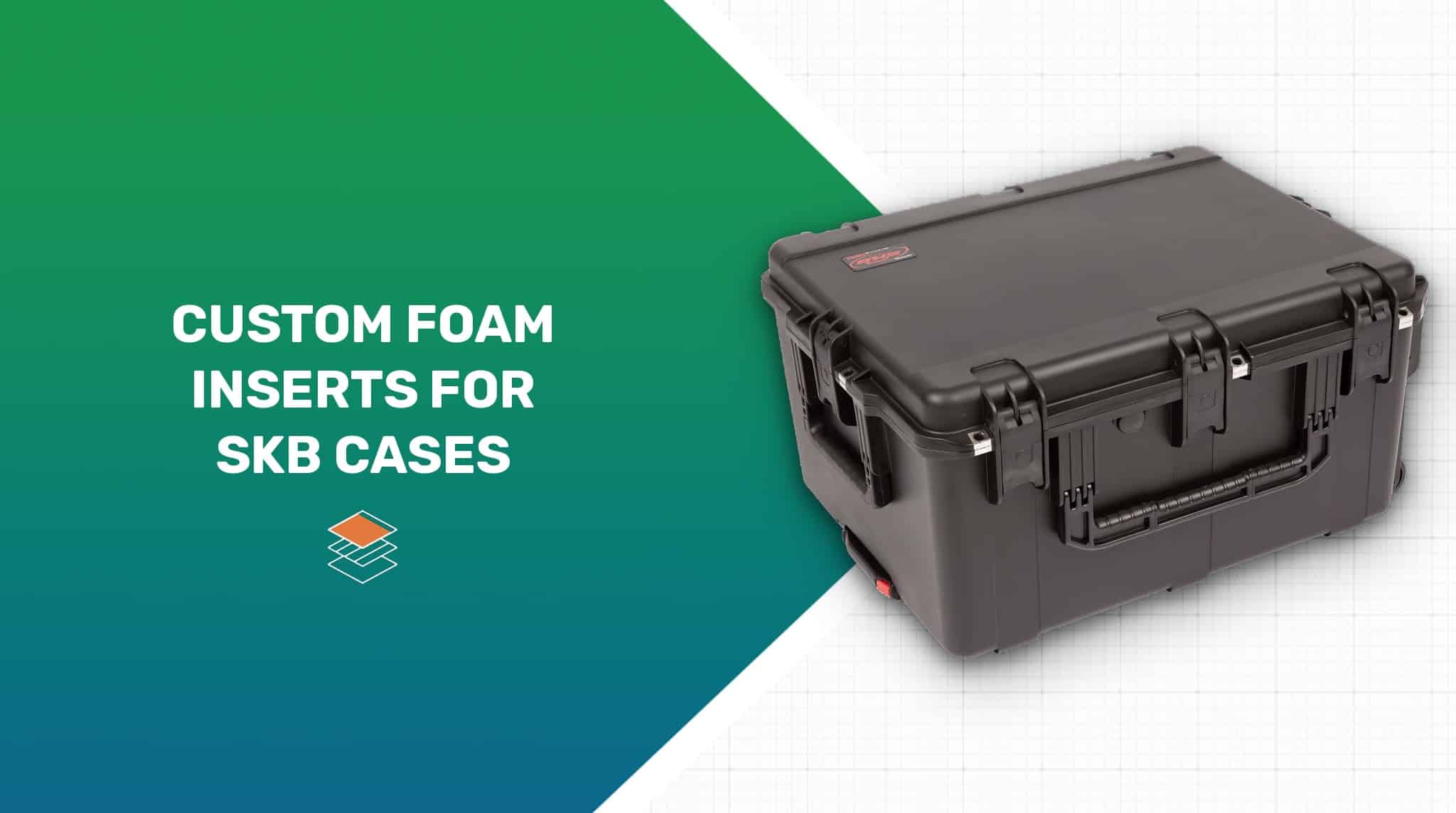
Custom Foam Inserts for SKB Cases
KEY TAKEAWAYS
- Closed-cell XLPE vs. open-cell PU: Cross-linked polyethylene (XLPE) provides rigid, chemical-resistant structural immobilization for heavy tools and chassis, while flexible open-cell polyurethane (PU) delivers soft, multi-impact deceleration for delicate optical lenses, displays, and top-lid cushioning.
- The failure of factory pick-and-pluck: Pre-cubed polyurethane foam degrades rapidly under repetitive field transit, losing compressive tension, tearing along perforated dice seams, and shedding abrasive polyurethane dust into sensitive connectors and optical housings.
- Precision automated fabrication vs. manual cutting: Advanced automated fabrication carves multi-depth stepped cavities, undercuts, and blind pockets directly from solid monolithic foam, delivering clean, perpendicular sidewalls without compression distortion, rough edges, or delaminating glue joints.
- Multi-density hybrid cushioning architecture: Advanced SKB iSeries configurations pair high-density XLPE base layers with two-tone contrasting tool control trays and convoluted open-cell PU lid foam, engineering an ATA-300 Category 1 transit enclosure that prevents equipment migration and internal collision.
- Turnkey CAD-to-foam fabrication with zero MOQs: American Foam Products (AFP) manufactures custom precision foam inserts for all SKB hard cases directly from customer STEP, DXF, or native CAD models with zero minimum order quantities, scaling seamlessly from single field prototypes to volume fleet deployments.
The vulnerability inside every military-spec SKB case
SKB hard cases, most notably the injection-molded SKB iSeries line, are industry benchmarks for transit protection across defense, aerospace, and commercial field deployments. Molded from ultra-high-strength polypropylene copolymer resin, these military-grade enclosures deliver IP67 waterproof submersion, impact resistance, and compliance with MIL-STD-810G, MIL-STD-C-4150J, and ATA-300 Category 1 standards. Technicians and procurement teams rely on SKB shells because the exterior armor is virtually indestructible.
However, an armored shell is only half of an effective packaging system. When calibrated diagnostics, tactical avionics, or sensitive broadcast packages suffer transit failure, the cause is rarely shell breach. It is interior movement, shock amplification, and progressive foam breakdown. Housing critical assets inside generic foam compromises mission readiness. True transit survivability requires custom foam inserts for SKB cases engineered specifically around payload weight distribution, fragility thresholds, and transit dynamics.
Why stock pick-and-pluck foam fails in harsh field environments
Most factory cases include pre-cubed ‘pick-and-pluck’ foam. While convenient for rapid consumer setups, perforated cubed foam introduces critical failure modes in demanding commercial and defense operations:
- Progressive cavity breakdown: Pre-cut perforations create thousands of microscopic stress concentrators. Under recurring vibration and handling, thin foam webs shear apart, enlarging pockets and allowing equipment to migrate and collide.
- Abrasive particulate contamination: As low-density open-cell foam flexes and oxidizes, it sheds micro-particulate. This foam dusting enters cooling fans, lens assemblies, and connectors, causing mechanical jamming and electrical faults.
- Bottoming-out failure: Diced foam lacks the compressive modulus required to decelerate heavy payloads. During high-impact drops, open-cell cubes compress completely, transferring unattenuated shock into delicate internal solder joints and mounts.
- Moisture retention: Open-cell foam absorbs ambient humidity, water, fuels, and solvents against metal housings, accelerating galvanic corrosion in harsh marine and field environments.
Upgrading to an engineered replacement foam for SKB case assemblies restores structural rigidity and protects sensitive assets over extended lifecycles.
Material science: selecting polyethylene vs. polyurethane for SKB enclosures
Selecting the proper polymer is the foundation of packaging engineering. While buyers often ask whether polyethylene or polyurethane is superior for an SKB case, high-performance packaging frequently combines both in an integrated multi-density assembly.
1. Cross-linked polyethylene (XLPE): the structural backbone
Cross-linked closed-cell polyethylene (such as Minicel and Plastazote) is the standard for high-wear military and industrial transit inserts. Its chemically cross-linked microcellular structure yields non-porous, smooth-skinned durability:
- Compressive memory: Ranging from 2.0 to 6.0 lb/cu.ft, XLPE supports high-mass tools and heavy chassis without permanent compressive creep or cell collapse across repetitive transit cycles.
- Chemical and moisture impermeability: Closed cells absorb virtually zero moisture (under 0.1% by volume) and remain inert against hydrocarbon fuels, lubricants, and hydraulic fluids.
- Cleanroom integrity and tool control: XLPE does not flake or shed particulate, protecting optical and Class-A surfaces. Two-tone laminated XLPE trays deliver instant visual verification of missing gear, satisfying Foreign Object Debris (FOD) standards.
2. Flexible open-cell polyurethane (PU): shock dissipation
Open-cell polyurethane is vital for cushioning fragile, low-mass components. Its interconnected cellular matrix forces air through microscopic pores during compression, transforming kinetic drop energy into thermal dissipation through viscous friction. In densities from 1.2 to 2.2 lb/cu.ft, PU keeps peak impact acceleration below sensitive fragility limits for optics and diagnostic electronics.
3. Multi-density hybrid architecture
The highest-performing SKB iSeries custom foam inserts leverage a composite approach: convoluted open-cell PU in the lid provides gentle vertical downward pressure to eliminate chatter, medium-to-high density closed-cell XLPE secures the primary payload laterally, and a dense closed-cell base pad absorbs bottoming-out drop energy.
Precision fabrication: monolithic cavity engineering and dimensional tolerances
Achieving exact tolerances requires automated, computer-controlled precision fabrication. We utilize advanced manufacturing systems to convert digital engineering models directly into turnkey custom foam inserts for hard cases:
Monolithic 3D cavity engineering: multi-tiered depth and ergonomic pocketing
Rather than laminating thin die-cut layers that separate under shear forces, advanced fabrication equipment carves custom cavities from solid, monolithic foam billets. This creates continuous interiors featuring multi-tiered depth steps, blind recesses, undercuts, cable raceways, and ergonomic finger-lift notches that distribute payload mass evenly without localized pressure points.
Perpendicular sidewall tolerances: eliminating edge distortion and compression
Manual cutting and mechanical stamping induce compression distortion, creating beveled edges and concave hourglass sidewalls. Industrial automated cutting applies controlled separation across thick foam blocks, delivering clean 90-degree perpendicular walls that prevent heavy components from shifting or unseating in transit.
Transforming SKB cases into mission-ready field systems
Custom foam fabrication elevates an SKB hard case from passive storage into an active, operational field platform:
- Aerospace and defense avionics: Custom antistatic (pink PU) and conductive (black XLPE) formulations mitigate electrostatic discharge (ESD) risks, safeguarding mission-critical navigation cards, FLIR optics, and encrypted transceivers.
- Broadcast and cinematic AV rigs: Precision custom foam for SKB cases organizes camera bodies, prime lenses, wireless audio receivers, monitors, and battery arrays into stacked, modular trays for rapid deployment and immediate inventory audits.
- Deployable diagnostic stations: Integrated pass-through wiring channels, bulkhead connector ports, and thermal vents allow field technicians to operate calibration stations and rugged laptops directly within the case.
Turnkey CAD-to-foam fabrication with zero minimum order quantities
B2B packaging procurement is often hindered by high minimum order requirements or expensive tooling fees. We eliminate these hurdles through a streamlined digital manufacturing process:
- Digital CAD ingestion: Submit 3D models (STEP, IGES, SolidWorks) or 2D vector files (DXF). We can also digitize equipment directly using precision coordinate measurement and 3D optical scanning.
- Cushion curve modeling: Packaging engineers evaluate mass, contact area, and drop height standards (such as MIL-STD-810G) to calculate exact foam densities and dynamic deflection clearances.
- Zero-MOQ rapid prototyping: We fabricate precision prototypes without minimum order thresholds or hard tooling charges, enabling rapid testing for single cases or small pilot batches.
- Production scaling: Approved digital toolpaths transfer directly to automated production lines, ensuring millimeter tolerances and repeatable quality across fleet deployments of any scale.
Engineer your SKB protective solution with American Foam Products
Your SKB case is built to withstand extreme transit punishment; the interior foam should be engineered to the exact same standard. Upgrading from disintegrating pick-and-pluck foam to custom-engineered closed-cell inserts prevents transit shock, ensures tool accountability, and maximizes field readiness.
At American Foam Products, we bring decades of specialized foam fabrication expertise, advanced production machinery, and a zero-MOQ manufacturing model to your packaging challenges. Contact us today to receive a quote for custom SKB foam inserts.
Recent Posts
- Expanded Polystyrene Foam: The Engineered Choice for Protective Packaging
- Custom Foam Inserts for SKB Cases

- Industrial Foam Fabrication and B2B Procurement Engineering: Technical Processes, Material Dynamics, and Unit Cost Optimization
- Pre-Holiday Supply Chain Optimization: Protecting Margins and Reducing Returns with Custom Inserts
- Navigating Standards for Fire Retardant Foam Compliance