(440) 352-3434

Blog
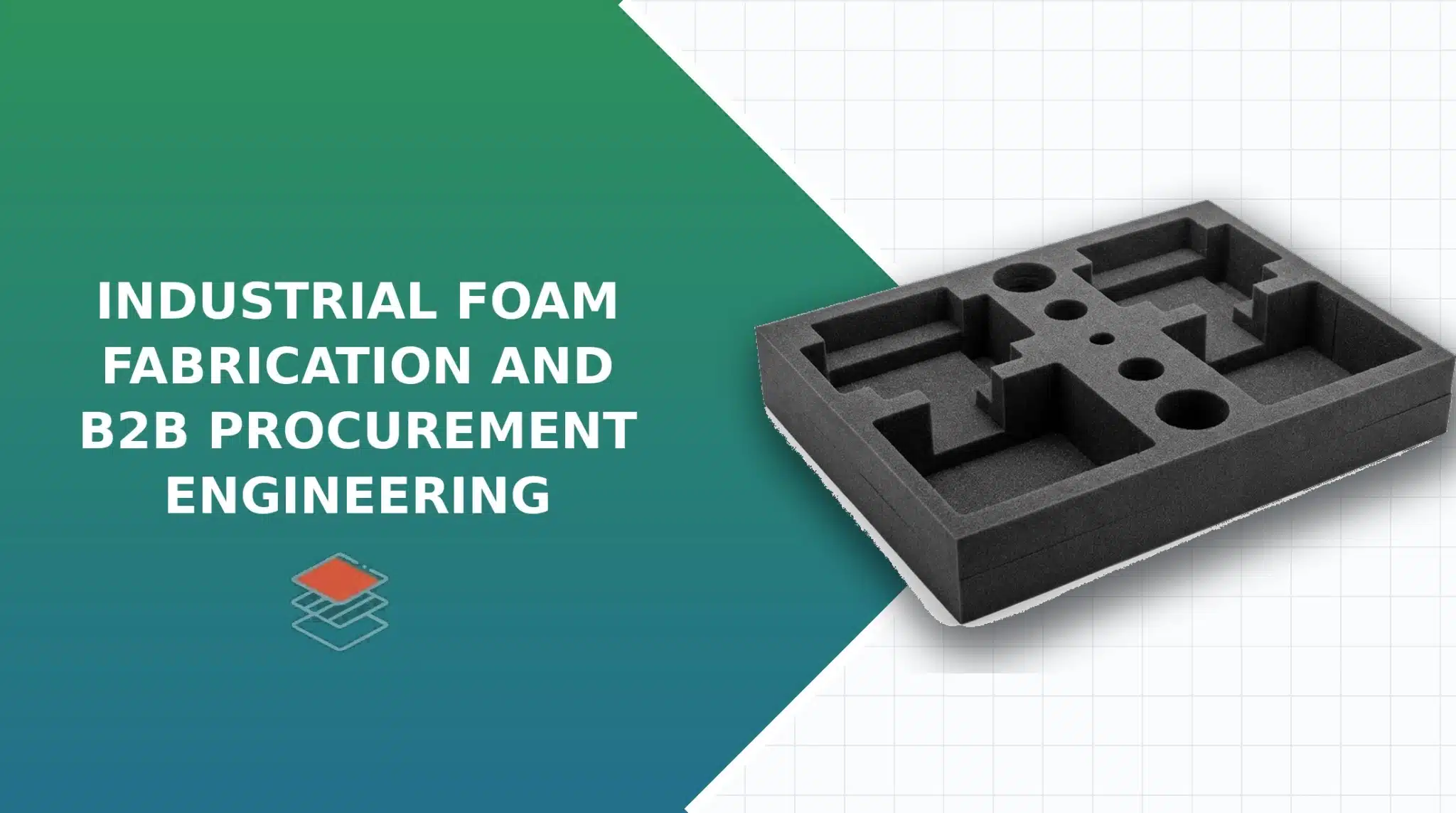
Industrial Foam Fabrication and B2B Procurement Engineering: Technical Processes, Material Dynamics, and Unit Cost Optimization
KEY TAKEAWAYS
- Tooling Amortization and Press Selection Drive Unit Cost: Initial steel-rule die tooling amortizes rapidly across production runs, slashing per-unit costs by up to 70% compared to short-run processes.
• Match Polymers to Function, Not Habit: Choosing foam by function avoids overpaying; low-cost Expanded Polyethylene (EPE) provides resilient multi-drop protection for single-use shipping, Cross-Linked Polyethylene (XLPE) delivers a smooth, non-abrasive finish for reusable trays and Class-A surfaces, and flexible Polyurethane (PU) cushions lightweight, sensitive electronics.
• Smart CAD Design Cuts Scrap by Up to 50%: Raw foam accounts for over half of total packaging costs. Designing custom foam packaging with common-line nesting, interlocking shapes, and layered through-stamped assemblies drastically reduces skeletal scrap while side-bevel tooling eliminates edge concavity and hour-glassing defects.
In manufacturing operations and high-volume distribution, protective packaging is often treated as a peripheral operational expense rather than a critical engineered sub-assembly. For procurement managers, manufacturing engineers, and product developers, this oversight frequently results in inflated recurring unit costs, unbudgeted shipping surcharges, and transit shock failures. Industrial foam fabrication transforms raw cellular polymers into custom foam packaging inserts designed to absorb dynamic impact, dampen vibration, mitigate thermal fluctuation, and provide electrostatic discharge (ESD) shielding. Achieving the lowest unit cost on large procurement orders requires an understanding of conversion mechanics, cellular polymer behavior, Design for Manufacturability (DFM) rules, tooling amortization thresholds, and transit simulation standards.
When packaging is treated as an afterthought, companies pay twice: first for oversized boxes filled with wasteful manual wraps or packing peanuts, and again when damaged goods trigger returns. By approaching custom packaging inserts as precision-engineered components from day one, procurement and engineering teams can lower piece-part costs, accelerate pack-line speed, and eliminate shipping headaches.
Material Selection Matrix: Polymers, Densities, and Board Foot Economics
Raw foam pricing is calculated using the Board Foot (FBM), equivalent to a 12″ x 12″ x 1″ solid slab: Length (in) x Width (in) x Thickness (in) / 144. Primary conversion splits bulk buns into target sheet thicknesses via horizontal band knife skiving before secondary stamping and fabrication. Skiving yields kerf losses (0.030″ to 0.060″ per slice), while nesting efficiency dictates net cost. Understanding cellular structure ensures you select the right performance tier without paying for unnecessary specs:
• Expanded Polyethylene (EPE): A non-cross-linked closed-cell foam that provides reliable multi-drop shock absorption, zero water absorption, and low raw material costs for single-use shipping cushions, appliance blocks, and end-caps. Because its surface can be slightly coarse, it is best for non-sensitive finishes and converted as flatbed die cut foam under 1.5″ thick.
• Cross-Linked Polyethylene (XLPE / IXPE): An engineered closed-cell foam with a smooth, micro-cellular texture. Chemical or electron-beam cross-linking gives XLPE high tear strength, superior chemical resistance, and a low compression set, meaning it springs back repeatedly under heavy loads. Its non-abrasive surface makes it the premier choice for Class-A automotive parts, medical trays, optics, and reusable military case inserts.
• Flexible Polyurethane (PU): An open-cell, breathable foam that feels soft and conforming. With Indentation Force Deflection (IFD 25%) ratings of 15 to 45 lbs, PU gently cushions delicate electronics, circuit boards, and optical lenses by venting air through its pores during compression. Specifying high-resilience ejection rubber and sharp side-bevel steel rules ensures clean, perpendicular cavity walls on parts up to 2 inches thick.
• Ethylene-Vinyl Acetate (EVA): A semi-rigid, rubber-like closed-cell copolymer known for its smooth satin finish, elasticity, and visual appeal. EVA is the standard for high-end retail presentation packaging, surgical trays, tool shadow boards, and compression-molded protective cases.
Design for Manufacturability (DFM): 4 Rules to Lower Unit Costs
Because raw foam accounts for 50% to 75% of finished packaging costs, simple adjustments during CAD modeling deliver immediate savings on the production floor:
• Prevent “Hourglass” Edges with Side-Bevel Tooling: When standard steel-rule blades stamp through foam thicker than 0.50″, the blade wedges the foam downward and sideways before shearing, leaving a concave “hourglass” edge upon recovery. Specifying side-bevel tooling places the flat vertical blade face against the finished part and pushes all compression into the scrap skeleton, keeping pocket walls straight and parts fitting snugly.
• Maximize Sheet Yield with Common-Line Nesting: Standard die layouts leave a 0.25″ to 0.375″ scrap border between parts. Common-line die configurations share a single rule between adjacent rectangular parts, eliminating scrap webbing and cutting press strokes in half. For irregular or L-shaped inserts, nesting parts in alternating interlocking orientations boosts sheet yield from 60% to over 85%.
• Layered Die-Stamped Assemblies for Multi-Depth Cavities: Holding components of varying heights within a single custom packaging insert is most cost-effectively achieved through layered die-stamped assemblies. The insert is split into 2D layers: an uncut base pad provides bottom support, while upper layers with through-stamped pockets are produced in seconds on a flatbed press. Joining the layers with thermal hot-plate lamination melts a micro-thin boundary for a permanent polymer bond without adhesive transfer tape, eliminating delamination risk and keeping the packaging fully recyclable.
• Maintain Practical Wall Thickness and Radii: Design cavity walls at least 0.50″ thick in closed-cell foams and 0.75″ in soft PU to prevent walls from collapsing during part insertion. Always specify rounded inside corners (minimum 1/8″ radius) rather than sharp 90-degree notches to eliminate blade stress points and prevent tears during stripping.
Tooling Amortization and Freight Density Optimization
Smart procurement balances upfront tooling capital against per-unit production costs across four volume tiers:
- Short-Run Production (Under 500 Units): Single-cavity flatbed steel-rule dies provide an accessible, low-capital entry point, establishing validated tooling without high financial exposure.
- Mid-Volume Scaling (500 to 2,500 Units): Steel-rule dies amortize rapidly across this volume window, dropping per-piece costs into the $4.50 to $8.00 range as multi-part nesting takes effect.
- High-Volume Production (2,500 to 10,000 Units): Multi-cavity flatbed tooling maximizes press bed utilization, stamping multiple parts per hit to lower unit costs to $2.75 to $4.50.
4. Mass Production (10,000+ Units): Rotary converting achieves $1.10 to $2.40 per unit for thin foams, while matched-aluminum compression molds become cost-effective for complex 3D contoured cushions by eliminating secondary assembly.
Freight density also impacts total cost. Because foam is mostly air, assembled box inserts often trigger high freight classes (NMFC Class 300 to 400), doubling shipping rates. Designing flat-pack or knock-down inserts with living hinges and puzzle-tab interlocks allows dunnage to ship flat on pallets at Class 70 or 85 density, slashing inbound freight by 60% to 80%.
Packaging Dynamics: Drop Testing and Quality Certification
Reliable packaging balances cushion firmness against product fragility. Under ASTM D1596 dynamic drop testing, cushion performance follows a U-shaped curve. If the foam is too stiff, it fails to compress and transmits sharp shock to the product. If the foam is too soft, it compresses completely (“bottoms out”), causing severe impact spikes. Engineers design within the optimal curve trough to keep transmitted shock safely below the product’s critical fragility limit (ASTM D3332 G-factor).
When drafting RFQs, reference ASTM D3575 physical callouts: Suffix B (Compression Set <15% to 20%) ensures inserts do not permanently deform in reusable dunnage, while Suffix BB (Compressive Creep <10%) prevents heavy equipment from sagging during warehouse storage. Validating packaging through ISTA 3A parcel drop tests and ISTA 6-Amazon fulfillment simulations guarantees transit durability, eliminates carrier chargebacks, and qualifies products for Frustration-Free Packaging (FFP).
RFQ Specification Guidelines and Fabricator Capability Audits
Vague technical specifications allow fabricators to make assumptions about material grades and assembly methods, often leading to unbudgeted cost creep or quality variance. When preparing an RFQ package for custom foam packaging, engineering and procurement teams should include four core parameters:
- Geometric CAD Data: Supply 2D vector CAD files (DXF or DWG) defining through-stamped cavities and score depths, paired with 3D assemblies (STEP or IGES) showing mating component clearances.
- Material Standards Callouts: Avoid generic terms like “2 lb black PE.” Specify exact polymer chemistry, density, and ASTM parameters (e.g., “Cross-linked Polyethylene, 2.0 pcf, ASTM D3575 Suffix B <15%, Color Black”).
- Edge Perpendicularity Limits: Set explicit concavity limits (such as “edge concavity must not exceed 0.040 inches from vertical profile”) to ensure tooling engineers specify side-bevel blades.
- Delivery Formats: Specify whether packaging should arrive as assembled kits, flat-pack knock-down sheets, or continuous kiss-cut rolls to align with warehouse assembly workflows.
Engineer Your Custom Packaging Strategy with American Foam Products
Eliminate unbudgeted tooling expenses, scrap waste, and transit damage with precision-engineered protective packaging. At American Foam Products, we partner with manufacturing engineers, procurement managers, and product developers across the Midwest and Mid-Atlantic to design custom, cost-effective foam solutions.
Contact us today to schedule a technical packaging audit, submit CAD files for DFM optimization, or request custom prototype samples.
Recent Posts
- Industrial Foam Fabrication and B2B Procurement Engineering: Technical Processes, Material Dynamics, and Unit Cost Optimization

- Pre-Holiday Supply Chain Optimization: Protecting Margins and Reducing Returns with Custom Inserts

- Navigating Standards for Fire Retardant Foam Compliance

- The Case Customization Guide

- Custom Foam Validation: The Science Behind Total Protection