(440) 352-3434
Blog
The Case Customization Guide
KEY TAKEAWAYS
- The Case Is Only Half the Defense: While rugged outer shells block external impacts, internal cushioning controls shock absorption, vibration damping, and environmental exposure; off-the-shelf “pick ‘n’ pluck” foam degrades under static loads and cyclic shock, risking equipment damage.
- Precision Material Selection Dictates Performance: Custom inserts match specific polymer properties, such as open-cell polyurethane for delicate vibration isolation, closed-cell polyethylene/XLPE for fluid resistance and structural durability, or carbon-loaded conductive foam for permanent ESD protection, to exact payload requirements.
- Engineered Protection Ensures Compliance & ROI: Custom-fabricated inserts optimize contact area to prevent bottoming out during drops, ensuring compliance with strict transport standards like MIL-STD-810H and ATA Spec 300 while extending reusable service life.
Protecting mission-critical field equipment requires far more than placing gear inside a rugged, injection-molded shell. While high-performance outer cases shield against external force, the interior cushioning system governs whether sensitive optics, calibration tools, and avionics survive transport intact. Investing in a premium case is only half the battle; the interior matrix serves as the frontline defense against vibration, destructive drop forces, and environmental contamination.
Off-the-shelf cushioning solutions fail under real-world industrial handling. Achieving true operational readiness and protecting your bottom line requires engineered, precision-cut custom foam case inserts tailored to the exact physical demands of your payload.
Why Off-the-Shelf Foam Fails
Generic, pre-cubed “pick ‘n’ pluck” foam interiors offer immediate convenience, but they introduce critical structural vulnerabilities that compromise high-value equipment. Over time, these temporary fixes lead to three major failure points:
- Structural Fatigue and Micro-Tearing: Pre-scored perforations act as stress concentrators. Under cyclic shock, transit vibration, or repeated equipment extraction, tears quickly propagate along the grid lines. As the internal walls rupture, the foam loses structural stiffness and can no longer support the weight of the hardware.
- Creep and Compression Set: Low-density open-cell matrices sustain permanent deformation under continuous static loads. When heavy hardware rests on unengineered foam during extended storage or transit, the microscopic cell walls collapse permanently. This creates internal void space, allowing equipment to shift freely and collide directly with the hard outer case wall during impact events.
- Contamination and Surface Damage: As these low-cost materials degrade, they crumble and shed abrasive particulate debris directly onto sensitive optical assemblies, laser lenses, and delicate circuit boards.
A stock insert might seem cost-effective initially, but the total cost of ownership skyrockets the moment a single piece of field equipment suffers transit damage.
Matching Foam to Payload Requirements
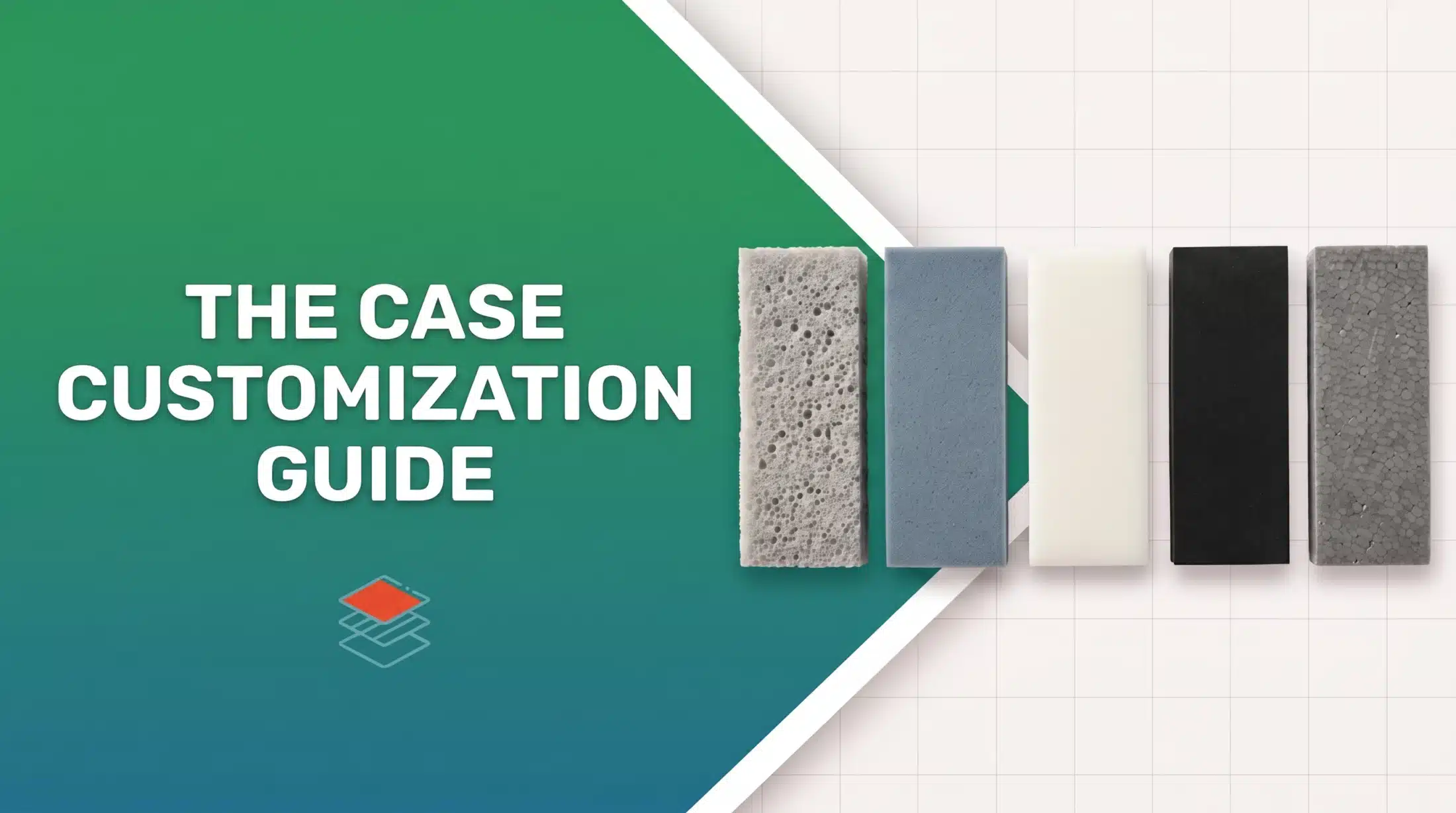
Engineered custom foam inserts solve these structural failures by replacing pre-scored, low-density materials with solid, high-density polymer blocks. Selecting the right protective foam requires balancing equipment weight, fragility, surface sensitivity, and chemical exposure.
Polyurethane (PU) Foam
Polyurethane is a soft, highly flexible, open-cell foam designed for light, delicate items. Because air flows freely through its interconnected cellular network, polyurethane excels at absorbing low-amplitude, high-frequency transit vibrations. It provides gentle cushioning for low-mass payloads like laboratory glassware, sensitive sensors, and delicate circuit assemblies. However, because its open-cell structure can absorb fluids, it should be used in sealed environments away from liquids and oils.
Polyethylene (PE) Foam
Standard polyethylene is a semi-rigid, closed-cell foam known for its structural strength and high load-bearing capacity. Because the individual gas cells are permanently sealed, polyethylene is naturally waterproof, hydrophobic, and resistant to chemicals, acids, and industrial solvents. It is ideal for blocking, bracing, and absorbing severe impact shocks from heavy industrial machinery, field pumps, motors, and tactical hardware.
Cross-Linked Polyethylene (XLPE)
Cross-linked polyethylene represents an advanced class of polyolefin foam where polymer chains are chemically tied together into a smooth, microcellular matrix. This process creates exceptional tear resistance, high tensile strength, and a smooth, non-abrasive surface finish that will not mark or scuff Class A painted finishes or polished optical lenses. XLPE produces zero particulate shedding and is resistant to moisture and harsh fluids, making it a standard choice for aerospace flight-line tools and medical instrument trays.
Ethylene Vinyl Acetate (EVA) and Expanded Polypropylene (EPP)
Ethylene vinyl acetate is a dense, high-toughness closed-cell copolymer with rubber-like flexibility and excellent edge retention, making it ideal for custom presentation kits and carved tool cavities. Expanded polypropylene is a durable bead foam engineered for extreme multi-impact energy management, capable of springing back to its original shape after severe impacts while resisting fuels and oils.
Electrostatic Discharge (ESD) Protection
For field technicians carrying sensitive printed circuit assemblies, semiconductors, or military avionics, static electricity presents an invisible hazard. Sliding non-conductive packaging materials against electronic components creates triboelectric friction, which can induce catastrophic component failure or latent defects that show up weeks later in the field.
Selecting the proper ESD protective foam depends on your operational environment:
- Anti-Static Foam (Pink): Polyurethane or polyethylene treated topically with chemical surfactants. These surfactants attract ambient atmospheric moisture to create a thin surface layer that dissipates static charges. However, anti-static pink foam is strictly intended for short-term, single-trip applications. In low-humidity environments like dry aircraft cargo holds or desert deployments, the surface moisture layer evaporates, leaving the equipment exposed. Furthermore, the migrating chemicals can outgas onto optics.
- Conductive Foam (Solid Carbon Black): Manufactured by permanently blending conductive carbon black directly into the polymer matrix. Conductive foam provides permanent, humidity-independent static protection that never degrades or outgases. When microelectronics are enclosed within high-density conductive foam, the material creates a continuous Faraday cage shield around the hardware, blocking external electrostatic fields and keeping lead pins safely grounded.
Dynamic Design Principles and Military Standards
Designing an effective protective insert requires applying sound cushioning principles. Equipment fragility is measured in units of peak acceleration force, known as its G-factor. Delicate equipment with a low G-rating requires thicker, softer foam to slow down impact deceleration gently. Rugged hardware can tolerate firmer, high-density foam matrices.
Engineered foam inserts balance the contact surface area against total equipment weight to keep the cushion operating in its elastic sweet spot. If a pocket surface area is too small for a heavy object, the foam will bottom out during a drop, causing high-energy shock waves to pass straight into the equipment. Conversely, if the contact area is too large for a lightweight item, the foam acts as a rigid wall, transmitting harsh vibrations directly into the payload.
Properly engineered custom case inserts ensure your entire transit system complies with stringent packaging standards:
- MIL-STD-810H Transit Drop Testing: Ensures loaded case systems survive 26 repeated drop impacts from a height of 48 inches onto wood-backed concrete, testing all flat faces, corners, and edges.
- ATA Spec 300 Category I Specification: Guarantees that multi-trip reusable shipping containers survive a minimum of 100 round-trip commercial air shipments without structural failure or equipment damage.
Upgrade Your Case Protection Today
A rugged outer case provides only half of the protective equation; the custom-engineered foam insert inside determines whether your mission-critical equipment arrives fully operational. Replacing stock, pre-cubed foam with engineered, high-density custom inserts eliminates structural fatigue, prevents chemical contamination, protects against static shock, and streamlines tool control.
Don’t leave high-value electronics, calibration gear, or optics to chance. Contact us at American Foam Products today to request a consultation and design a custom foam insert engineered specifically for your application.