(440) 352-3434
Blog
Understanding ESD Foam Solutions for Electronics
Safeguarding sensitive microelectronics during transit requires far more than basic cushioning; it demands specialized electrostatic discharge mitigation. Standard packaging materials often accumulate static charges that can destroy delicate components, leading many engineers to question: is foam anti-static by default? Dedicated ESD foam engineered from conductive or anti-static foam formulations provides the precise resistivity needed for reliable static dissipation throughout the supply chain.
By combining custom-engineered antistatic foam with high-density shock absorption, these specialized inserts protect high-value devices from both physical impacts and silent electrical damage. We’ll explore the material science behind electrostatic protection, contrasting surface-treated options with volume-conductive materials to help procurement managers choose the optimal solution for high-tech electronics.
The Hidden Risk: Why Standard Foam Threatens High-Value Electronics
A high-performance protective case provides an exceptional hard-shell defense against external impacts. However, the case is only half the system; the foam interior handles the internal micro-environment. A common misconception among engineers and purchasing agents is assuming that off-the-shelf plastic cushioning inherently prevents static buildup.
In their natural, unmodified states, standard polymers like polyethylene, polyurethane, and polystyrene are electrical insulators. During transit, as equipment slides against generic foam or as technicians handle components, a phenomenon known as triboelectric charging occurs. This friction transfers electrons between surfaces, leaving standard insulating foam with a dense, localized electrostatic charge.
Because insulating materials lack free charge carriers, these static charges cannot escape or route to a grounded path. Instead, they sit trapped on the foam’s surface, creating massive electrostatic fields. Under typical transport conditions, especially in low-humidity environments, unmodified packaging can routinely generate thousands of volts.
When a sensitive integrated circuit or bare printed circuit board (PCB) enters this field, the potential difference causes a rapid, microsecond-duration discharge event. Modern microchips can experience catastrophic breakdown or physical gate-oxide damage from static events at potentials as low as 20 volts.
Even worse are latent ESD defects. A minor discharge may partially degrade internal component pathways without triggering immediate system failure. The assembly passes initial factory quality tests, only to suffer premature failure months later in the field, leading to costly warranty claims and damaged customer trust.
The Superior Solution: Custom ESD Foam Inserts from American Foam Products
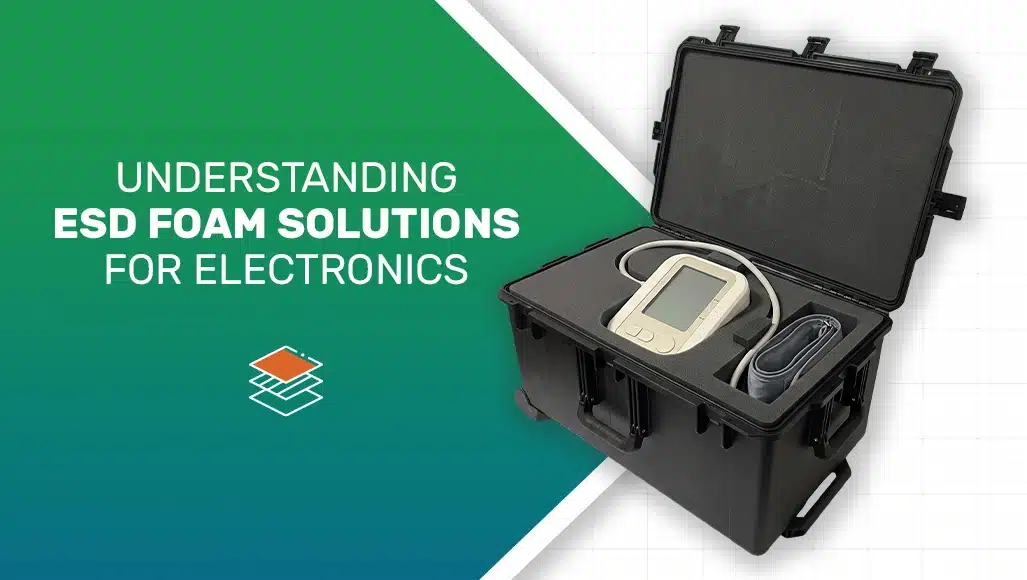
Generic pick-n-pluck foam cubes degrade over time, lose structural tension, and fail to provide the controlled electrical properties required for microelectronics. Custom-fabricated electrostatic discharge (ESD) foam inserts offer an engineered solution that solves both mechanical and electrical hazards simultaneously.
Custom-engineered ESD inserts deliver three core advantages:
- Controlled Resistivity: By utilizing materials engineered for static dissipation, charge buildup bleeds off at a safe, continuous rate rather than discharging in a destructive spike.
- Precision Structural Support: Custom CNC routing contours the foam to match your exact hardware profile, eliminating damaging migration inside the case during transit.
- Long-Term Durability: High-grade industrial foams do not flake, crumble, or lose their anti-static integrity over time, guaranteeing multi-trip reliability.
Material Science & Fabrication: The Chemistry of Electrostatic Mitigation
To select the correct protective foam, engineers and procurement specialists must understand how different ESD materials dissipate static charges.
Surface-Treated (Pink) Foams vs. Volume-Conductive (Black) Foams
Pink anti-static foam achieves its properties through additive surfactants, such as Glycerol Monostearate (GMS), blended into the base polymer. After manufacturing, these additives migrate (“bloom”) to the outer cell surface. The surfactant draws moisture from ambient air, forming a microscopic layer that allows static charges to bleed off gradually.
Black static-dissipative and conductive foams incorporate high-structure conductive carbon black directly into the polymer matrix during manufacturing. This creates a permanent, three-dimensional electrical network across the entire volume of the material. Conductive carbon-loaded foams offer:
- Permanent Protection: The static-dissipative capability never wears out, outgases, or degrades over time.
- Environment-Independent Performance: Protection remains constant regardless of ambient humidity levels.
Polymer Matrices: PE, XLPE, and PU
Choosing the correct polymer matrix ensures the foam meets the physical demands of your product weight and cleanliness requirements:
- Polyurethane (PU): An open-cell material providing soft, flexible cushioning. Ideal for dampening low-amplitude vibrations around lightweight components.
- Expanded Polyethylene (PE): A closed-cell, semi-rigid foam ideal for heavier assemblies requiring firm shock resistance and moisture rejection.
- Cross-Linked Polyethylene (XLPE): The gold standard for cleanroom equipment and high-reliability electronics. Chemically bound polymer chains form a smooth, non-abrasive surface that will not flake or shed particulates. XLPE resists chemicals and exhibits virtually zero outgassing, ensuring delicate sensors and optics remain free from film residue.
Upgrade Your Electronics Protection Today
When shipping high-value avionics, medical sensors, or microelectronics, relying on generic packaging introduces significant risks. The outer case provides external strength, but a custom-engineered ESD foam insert delivers the shock absorption and electrostatic mitigation necessary to preserve component integrity.
Don’t let silent electrostatic discharge or transit shock compromise your product performance. Contact us at American Foam Products today to discuss your project requirements and receive a custom solution tailored to your application.