(440) 352-3434

Blog
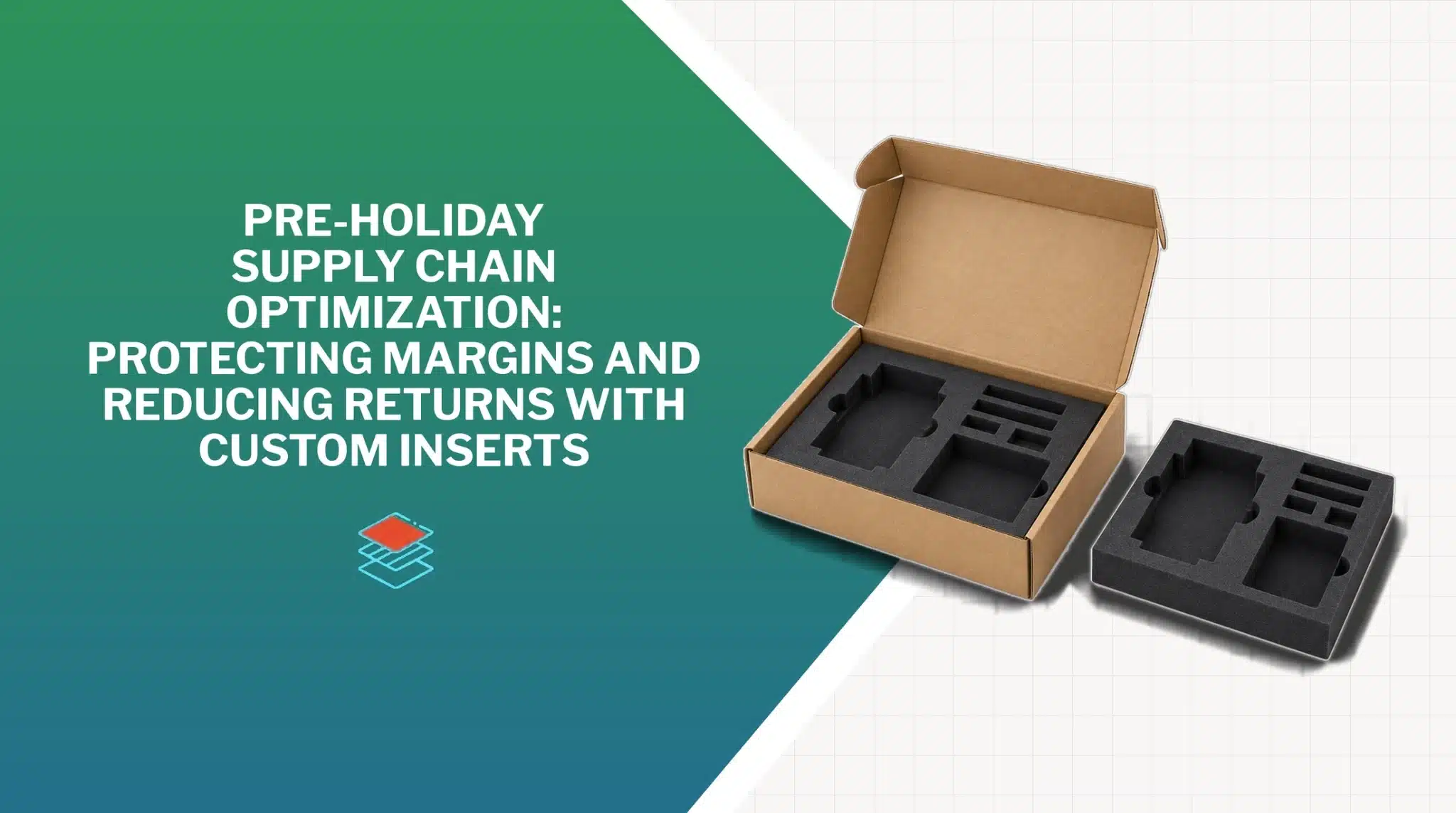
Pre-Holiday Supply Chain Optimization: Protecting Margins and Reducing Returns with Custom Inserts
KEY TAKEAWAYS
- Slash Dimensional Weight (DIM) Penalties: Transitioning from oversized boxes and loose void fill to engineered foam inserts for boxes minimizes outer carton volume, maximizing pallet density and neutralizing peak-season carrier surcharges.
- Stop Reverse Logistics Margin Bleed: Holiday return rates average nearly double regular retail levels, with damage being a primary driver; precision-engineered custom foam inserts lock components in place to prevent shock, vibration, and impact failure.
- Accelerate Pack-Line Throughput: As temporary seasonal fulfillment staff scales up, intuitive custom cut foam inserts replace inconsistent multi-step manual wrapping with foolproof drop-in assembly, drastically cutting pack times.
As supply chain and operations leaders prepare for the fourth-quarter peak, logistics networks face their annual stress test. Between holiday carrier surcharges, tight delivery windows, and heightened consumer expectations, margin preservation hinges on packaging execution.
During the holiday shipping rush, supply chains do not just move more parcels; they move them through overburdened sorting hubs and rough automated handling systems. If your packaging strategy relies on generic corrugated cartons and loose void fill, your products are exposed to transit hazards, carrier dimensional weight penalties, and costly returns.
Optimizing your packaging density and integrating custom foam inserts before peak volume hits is one of the most effective strategies to protect product integrity, streamline fulfillment velocity, and safeguard holiday profitability.
The Q4 Logistics Crunch: Dimensional Weight and Freight Surcharges
Every holiday season, parcel carriers such as FedEx, UPS, and regional couriers institute demand surcharges and enforce stringent Dimensional Weight (DIM) pricing. DIM pricing calculates shipping rates based on package volume (Length × Width × Height / DIM divisor) rather than actual weight. If you ship lightweight or moderately sized goods in oversized stock cartons packed with air pillows or packing peanuts, you are essentially paying premium freight rates to transport empty space.
The Operational Hidden Cost of Loose Void Fill
- Inflated Shipping Costs: Larger outer dimensions push cartons into higher DIM weight brackets, directly multiplying your shipping cost across tens of thousands of Q4 shipments.
- Poor Pallet & Container Utilization: Bulkier cartons reduce the number of units fitting on a standard 48×40 pallet, requiring more pallet positions, raising line-haul freight costs, and congesting distribution center staging areas.
- Inconsistent Protection: When pack-line operators manually decide how much wrap or paper to add, protection levels fluctuate wildly from one box to the next, causing unpredicted drop damage.
By replacing loose fill with tailored foam inserts for boxes, packaging engineers can design the outer shipping container around the exact dimensions of the product and its protective envelope. High-performance packaging foams provide targeted shock absorption in a significantly thinner profile than loose paper or air cushions. By eliminating wasted headspace and perimeter volume, you can downsize the primary shipping carton by 20% to 40%. Across a full Q4 fulfillment cycle, that reduction delivers compounding savings in carrier base rates and seasonal fuel surcharges while allowing you to pack more inventory onto every trailer.
Mitigating the High Cost of Holiday Returns
While outbound shipping costs draw executive scrutiny, inbound reverse logistics quietly erode holiday margins. Industry benchmarks show that e-commerce return rates spike significantly between November and January. When a product arrives broken, cosmetically marred, or malfunctioning, the manufacturer absorbs a compounding series of losses: inbound return freight, inspection and triage labor, write-offs of damaged inventory, and compromised customer loyalty during the most critical buying window of the year.
Corrugated dividers and folded paperboard often fall short under multi-impact drop cycles. Different goods demand specific foam chemistries to counteract physical shock, deceleration forces, and abrasive friction:
• Polyethylene (PE) Foam: Ideal for non-fragile to semi-fragile industrial goods, tools, and consumer products requiring resilient, multi-drop cushioning and high compressive strength.
• Cross-Linked Polyethylene (XLPE) Foam: A premium, closed-cell material offering superior tear resistance, smooth non-abrasive surfaces, and zero particulate shedding. Perfect for medical devices, high-end electronics, and items with sensitive finishes.
• Polyurethane (PU) Foam: An open-cell, flexible foam suited for delicate, lightweight instrumentation requiring gentle deceleration and contouring around complex geometries.
Integrating custom foam inserts ensures that every sensitive component, calibrated dial, glass surface, or cosmetic housing is held securely in 3D space, preventing internal collision and isolating the product from structural box deformities during transit.
Enhancing Pack-Line Velocity Under Peak Volume
Q4 supply chain optimization is not limited to freight trucks; it begins on the fulfillment floor. During peak shipping, fulfillment centers routinely onboard temporary warehouse personnel to manage throughput spikes. Complex, multi-step packaging protocols that require measuring, wrapping, taping, and stuffing lead to packaging errors and bottlenecked shipping lines.
By engineering custom cut foam inserts with molded or routed nesting pockets, you turn packaging assembly into an intuitive, error-proof operation. Temporary workers do not need to guess how much void fill is sufficient; the cavity guides the product directly into place. Incorporating ergonomic features such as precision finger-lift cutouts ensures components can be quickly inserted and removed without tearing the insert or slowing down throughput.
The Brand Impact: Delivering a Premium Unboxing Experience
For consumer brands, specialized manufacturers, and B2B suppliers alike, the holiday delivery is often the primary physical touchpoint between brand and end-user. When an order arrives buried in crumpled newsprint, surrounded by messy static-cling packing peanuts, or dented from shifting inside a box, brand perception suffers.
Custom-fabricated packaging bridges the gap between industrial-grade protection and presentation-quality aesthetics. A clean, two-tone or precision-routed insert conveys craftsmanship and quality before the customer even powers on or inspects the item. It transforms opening the carton from a messy unpacking chore into a curated unboxing experience, reinforcing customer confidence and discouraging unwarranted returns.
Structuring Your Pre-Q4 Packaging Timeline
Supply chain readiness requires adequate lead time for material selection, CAD modeling, and prototype verification. Waiting until late autumn to address packaging design bottlenecks often results in expedited tooling fees, limited material availability, and rushed testing. Follow this structured roadmap to ensure seamless execution:
| PHASE | TARGET TIMELINE | CRITICAL OBJECTIVES |
| 1. Packaging Audit & Dimensioning | Late Summer (July–August) | Evaluate carton dimensions, historical Q4 damage reports, and carrier DIM weight exposure. Identify SKUs with high return rates. |
| 2. CAD Design & Prototyping | August–September | Provide product samples or STEP/CAD files. Formulate insert geometries, finger pulls, and material combinations (PE, XLPE, PU). |
| 3. Testing & Validation | September | Conduct drop testing, vibration simulation, and pack-line velocity assessments using physical prototypes. |
| 4. Full Production & Staging | Late September–October | Manufacture production runs of custom cut foam inserts and stage inventory across regional fulfillment nodes ahead of November volume spikes. |
Engineer Your Holiday Packaging Strategy with American Foam Products
Do not let shipping damage, bloated dimensional weight charges, and preventable returns derail your fourth-quarter operating margins. At American Foam Products, we partner with operations managers, packaging engineers, and supply chain directors across the Midwest and Mid-Atlantic to engineer custom, cost-effective packaging solutions.
Contact us today to schedule a packaging audit, evaluate your dimensional weight exposure, and request a custom prototype sample.
Recent Posts
- Industrial Foam Fabrication and B2B Procurement Engineering: Technical Processes, Material Dynamics, and Unit Cost Optimization

- Pre-Holiday Supply Chain Optimization: Protecting Margins and Reducing Returns with Custom Inserts

- Navigating Standards for Fire Retardant Foam Compliance

- The Case Customization Guide

- Custom Foam Validation: The Science Behind Total Protection