(440) 352-3434
Blog
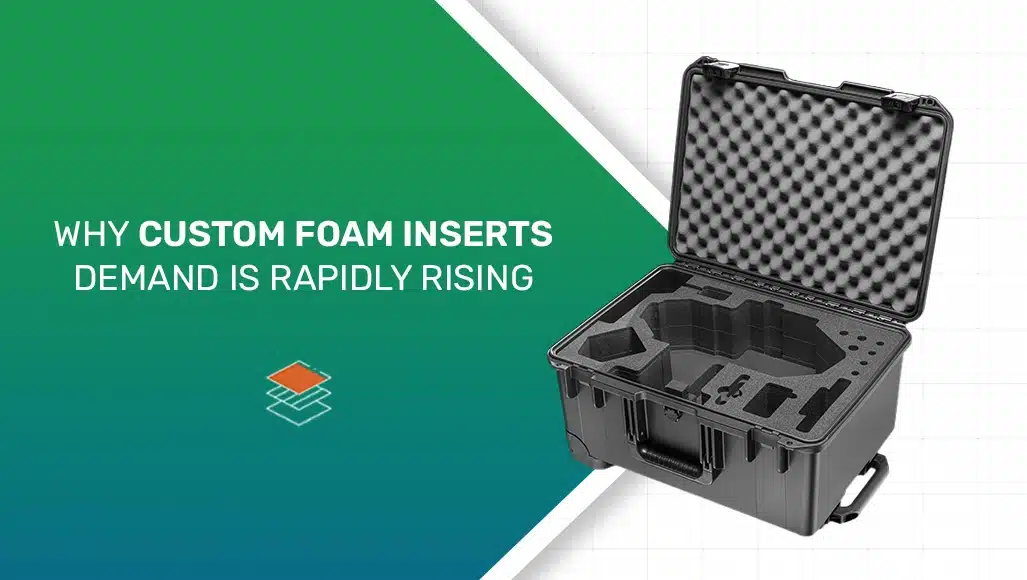
Why Custom Foam Inserts Demand is Rapidly Rising
Investing in a high-end protective case, whether it’s a Pelican, Nanuk, or a custom flight case, is a smart move for any professional. However, the case itself is only half of the protection equation. As global supply chains become more complex and the value of specialized equipment increases, professionals are realizing that what sits inside the case is what truly determines the safety of their assets.
The demand for high-performance custom foam inserts is reaching an all-time high because standard, off-the-shelf packaging has reached a critical breaking point. For sectors like aerospace, medical instrumentation, and semiconductor manufacturing, a generic solution is no longer a viable option.
The Hidden Risk: Why Standard Packaging Fails
Many professionals initially rely on pick-and-pluck foam or generic materials like bubble wrap. While these seem convenient, they often fail to provide consistent foam cushion support.
Traditional materials like bubble wrap rely on air pockets that can burst or leak during a single journey, leading to a reduction in effectiveness. Furthermore, lightweight cushioning often bottoms out when protecting items over 15 lbs, transferring the full force of an impact directly to your equipment.
Generic foam also struggles with shifting risks. During transit, constant vibration can cause a heavy item to migrate through loose materials until it hits the outer wall of the case. This lack of immobilization is a primary cause of surface abrasion and internal misalignment in sensitive electronics. Custom solutions eliminate these risks by providing a precision-engineered foam cutout filler that keeps every component perfectly stationary.
The Material Science of Superior Protection
A key reason for the shift toward custom inserts is the ability to select materials based on specific mechanical properties. Unlike generic foam, custom solutions allow engineers to tune the polymer to match the fragility of the asset.
Polyurethane (PU): The Damping Specialist
Polyurethane is an open-cell foam, meaning its cell walls are not entirely sealed. This makes it highly compressible and springy, which is ideal for vibration damping and protecting very lightweight items like optical lenses or high-fidelity audio equipment.
Polyethylene (PE): The Industrial Powerhouse
Polyethylene is a closed-cell material where each cell is a discrete, air-filled pocket. This structure makes it naturally water-resistant and rigid, providing high load-bearing capacity for heavier industrial components and medical machinery.
Cross-Linked Polyethylene (XLPE): The Apex of Durability
For Class A surfaces, those that are highly polished or finished, XLPE is the gold standard. It features an extremely fine, non-abrasive cell structure that won’t scratch luxury goods or medical implants. It also offers the highest temperature resistance, maintaining its integrity up to 194°F.
Engineering the Perfect Fit
Custom foam isn’t just about cutting shapes; it’s about physics. Modern designers use cushioning curves and fragility ratings to ensure that if a case is dropped, the foam absorbs the kinetic energy and reduces the G-force experienced by the product.
Choosing the right foam density is critical. If the foam is too dense, it acts like a brick and transmits the shock directly to the item. If it is too soft, the item will bottom out. Custom inserts allow for the precise calculation of the Static Loading, the weight of the item divided by the area of the foam touching it, to find the sweet spot of protection.
The Economic Reality: ROI and Longevity
While custom foam has a higher upfront cost than bubble wrap, a Total Cost of Ownership (TCO) analysis shows it is the more economical choice over time. Transit damage is a massive financial drain, accounting for 31% of all e-commerce returns. According to 2026 research, damaged or defective items are actually the most common reason for initiating a return.
A Strategic Investment in Asset Longevity
The shift toward customization is a permanent structural change in how we handle professional assets. As technology becomes more valuable and more fragile, the protective margin provided by engineered foam becomes a critical differentiator in brand reliability. Professionals who choose custom-fabricated solutions aren’t just buying packaging; they are investing in a sophisticated engineering solution that guarantees asset longevity and professional excellence.
Ready to elevate your equipment protection? Contact us at American Foam Products today to discuss your next custom project.