(440) 352-3434
Blog
Elevate Your Nanuk Case with Custom Foam Inserts
Key Takeaways
- Standard “pick-and-pluck” foam has structural weaknesses, as its pre-scored grid is prone to tearing and degrading, leading to a loose fit that compromises long-term protection.
- Closed-cell polyethylene (PE) foam is the superior material for protecting heavy gear, as its rigid, non-absorbent structure resists “bottoming out” and is impervious to water and chemicals.
- Precision fabrication like CNC routing creates the most durable insert by carving custom pockets from a single, solid block of foam, eliminating weak points like glue or seams.
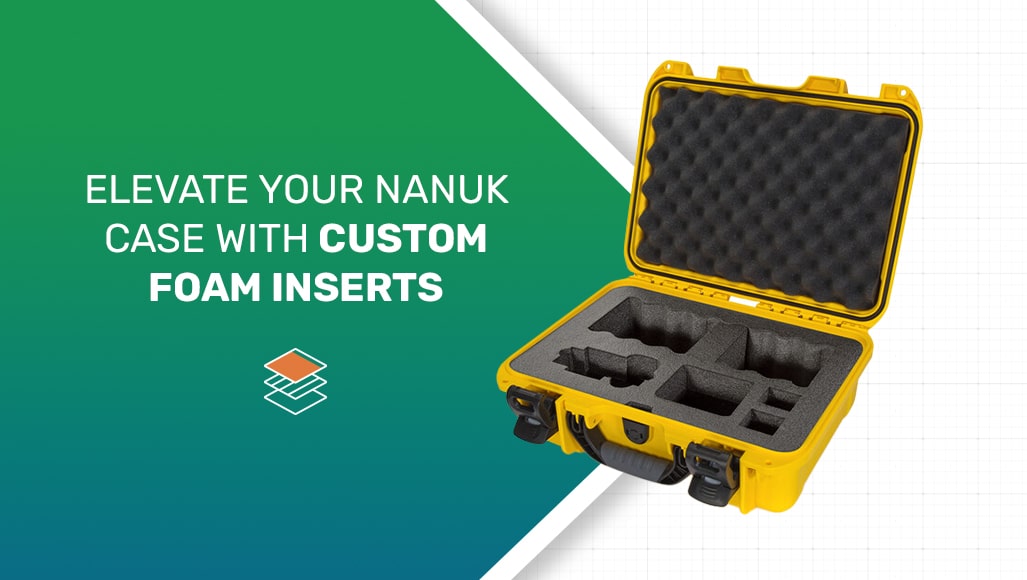
You’ve made a smart investment in a Nanuk case. You recognize that protecting your valuable, mission-critical equipment—whether it’s high-end camera gear, sensitive scientific instruments, tactical equipment, or industrial tools—starts with a world-class protective shell. Nanuk cases are legendary for their ability to shrug off severe impacts, water, and dust. But the case itself is only half of a complete protective system. The true measure of protection is found on the inside.
The standard “pick-and-pluck” foam that comes with many cases is a convenient starting point, but it’s not a permanent solution. For gear that truly matters, you need a solution engineered with the same precision and durability as the case itself. You need a custom Nanuk case foam insert.
At American Foam Products, we specialize in transforming your high-performance case into a total protection system. We move beyond the limitations of generic foam to provide professionally fabricated foam inserts for your Nanuk case that offer unparalleled shock absorption, organization, and long-term durability. This is the ultimate upgrade for your equipment’s safety and your peace of mind.
The Hidden Risks of Standard Foam
To appreciate the value of a custom solution, it’s important to understand the compromises inherent in standard-issue foam options. Most Nanuk cases come with one of two interiors: cubed foam or padded dividers. While they serve a purpose, they fall short for demanding applications.
“Pick-N-Pluk” (Cubed) Foam: Convenience vs. Durability
The most common option is “Pick-N-Pluk” or cubed foam. It’s a block of polyurethane foam that’s been pre-scored into small cubes, allowing you to pluck out a general shape for your gear.
- The Advantage: It’s fast and easy. You can create a cavity for your gear in minutes without any special tools.
- The Disadvantage: This convenience comes at a significant cost to protection and longevity. The pre-scored grid creates an inherent structural weakness. The thin foam walls between plucked sections are prone to tearing and degrading over time, especially with frequent use. This leads to a progressively looser fit, allowing your valuable equipment to shift during transport. Over time, the foam breaks down, shedding small particles that can infiltrate sensitive electronics or optics. For any gear that isn’t a perfect square, cubed foam leaves gaps, resulting in uneven support and compromised shock absorption.
Padded Dividers: Flexible but Flawed
Padded dividers offer excellent reconfigurability. Using hook-and-loop fasteners, you can easily change your layout, which is great for a kit that evolves, like a photographer’s lens collection. However, this flexibility sacrifices ultimate protection. Dividers are good for organization and preventing items from bumping into each other, but they offer minimal shock absorption and vibration dampening compared to a precisely fitted foam insert. Irregularly shaped items can still slide and shift within their compartments, leaving them vulnerable to damage from a serious impact.
For equipment worth hundreds or thousands of dollars, relying on a “good enough” solution introduces unnecessary risk. A professionally fabricated insert is the only way to guarantee a perfect, secure fit that provides maximum protection, trip after trip.
The Science of Protection: Choosing the Right Foam Material
The single most critical decision in designing a custom insert is selecting the right foam. The material’s physical properties dictate its ability to absorb impact, support weight, and resist environmental factors. At American Foam Products, our expertise begins with foam science.
All protective foams fall into two main categories: open-cell and closed-cell.
Open-Cell Foam: The Cushioning Specialist
Polyurethane (PU) is the most common open-cell foam—it’s what Pick-N-Pluk foam is made of. Its interconnected cells create a soft, sponge-like material that excels at cushioning.
- Best For: Lightweight, highly fragile items like camera bodies, lenses, delicate lab instruments, and consumer electronics.
- How it Works: When an impact occurs, air is pushed out of the cells, allowing the foam to compress easily and absorb the shock, much like a memory foam mattress.
- Limitations: Because the cells are open, PU foam readily absorbs moisture, making it unsuitable for damp environments. It’s also less durable under heavy loads and can “pack out” or permanently compress over time.
Closed-Cell Foam: The Structural Support Powerhouse
Polyethylene (PE) is the workhorse of high-performance protective inserts. In this foam, each cell is a tiny, sealed pocket of gas, making the material far more firm, rigid, and durable.
- Best For: Heavy or high-value equipment that requires firm support, such as firearms, industrial tools, drones, and military gear.
- How it Works: The trapped gas in the sealed cells resists compression, allowing the foam to cradle heavy items without collapsing or “bottoming out” against the hard wall of the case.
- Key Benefits: PE foam is non-absorbent, making it completely resistant to water, chemicals, mold, and mildew. It is exceptionally durable and allows for inserts to be designed with thinner walls between items without sacrificing strength.
Premium & Specialty Foams
For specialized applications, we also offer advanced materials:
- Cross-Linked Polyethylene (XLPE): A premium, ultra-smooth version of PE foam. Its non-abrasive surface is perfect for protecting “Class A” finishes on medical devices, sales demo kits, and museum-quality items.
- Ethylene-Vinyl Acetate (EVA): A semi-rigid closed-cell foam that offers a fantastic balance of cushioning and support. It’s lightweight, water-resistant, and available in multiple colors, making it ideal for organizational color-coding in cases for gaming accessories, microphones, or premium product packaging.
The Professional’s Edge: Precision Fabrication Technology
Once the perfect material is chosen, bringing the design to life requires industrial-grade technology. While a dedicated DIYer can achieve a decent result, professional fabrication offers a level of precision, repeatability, and structural integrity that is simply unattainable by hand. This is where American Foam Products truly shines. We utilize state-of-the-art equipment to create the perfect foam inserts for your Nanuk case.
CNC Routing: Monolithic Strength
Computer Numerical Control (CNC) routing uses a high-speed, computer-controlled cutting bit to carve your custom insert from a single, solid block of foam.
- The Unbeatable Advantage: This process creates complex pockets at multiple depths within one monolithic piece. There is no layering and no glue. This results in the strongest, most durable insert possible, with no seams that could delaminate or fail over time. For a Nanuk 904 case with foam holding a camera and lenses, CNC routing can create a shallow pocket for the body and a deeper one for the lens, all from one solid block. It is the gold standard for heavy equipment requiring maximum structural support.
Waterjet Cutting: Unmatched Precision
This technology uses a hyper-pressurized stream of water mixed with a fine abrasive to slice through foam with surgical precision.
- The Precision Advantage: Waterjet cutting can produce incredibly intricate designs with perfectly smooth, clean edges. Because it’s a cold process, there is no heat to affect the foam’s properties. This makes it ideal for any foam type, from the firmest PE to the softest PU. For a Nanuk 910 case with foam protecting highly complex medical instruments, a waterjet delivers flawless contours and an aesthetic finish that is second to none.
Your Perfect Fit is a Simple Process
We believe that getting a professional-grade custom foam insert should be easy and collaborative. Our process is designed to take the guesswork out of protecting your gear.
- Consultation & Needs Assessment: It starts with a conversation. You tell us what you need to protect and how you’ll be using it. We’ll discuss everything from equipment weight to operational needs.
- Expert Design & Material Selection: Our engineering team gets to work. Using your equipment or precise CAD files, we design the optimal layout. We’ll recommend the ideal foam—be it PE for durability or EVA for aesthetics—and present you with a technical drawing for your approval.
- Precision Fabrication: Once you approve the design, our advanced CNC routers or waterjet cutters create your insert with exacting precision. Whether it’s a single insert for your personal gear or a large production run for your business, our quality is consistent.
- Guaranteed Fit & Delivery: Every insert is subjected to rigorous quality control to ensure dimensional accuracy and a perfect fit inside your Nanuk case before it is shipped directly to you.
Your Nanuk Case is Only Half the Solution
Your investment in a Nanuk case shows you’re serious about protection. Now it’s time to complete the system. Moving beyond the limitations of standard cubed foam and upgrading to a professionally designed and fabricated insert from American Foam Products isn’t an expense—it’s an insurance policy for your most valuable assets.
Don’t let a poor-fitting, degrading foam insert be the weak link in your protective chain. Give your equipment the security it deserves with a solution built for perfect fit, maximum shock absorption, and long-term durability.
Ready to elevate your protection? Contact the experts at American Foam Products today for a free consultation. Let us design the perfect Nanuk case foam solution for you.