(440) 352-3434
Blog
The Ultimate Buyer’s Guide to Custom Seahorse Case Foam
Key Takeaways
- Upgrade from “pick-n-pluck” foam, which offers poor protection and degrades quickly, to a custom-cut insert for a significantly lower Total Cost of Ownership (TCO) by preventing equipment damage.
- Material choice is critical for protection; closed-cell foams like Polyethylene offer rigid, water-resistant durability for heavy gear, while open-cell Polyurethane provides superior cushioning for lightweight, delicate items.
- Proper design is essential for shock absorption, requiring a “buffer zone” of at least 1-2 inches between your equipment and the case wall to allow the foam to compress and dissipate impact.
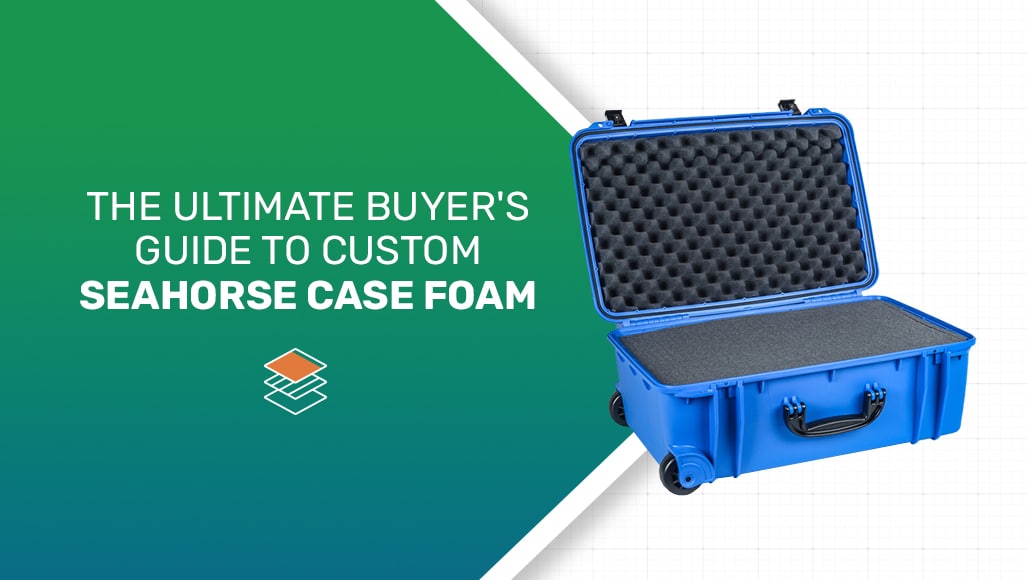
You’ve already made a smart investment by choosing a Seahorse protective case. Its rugged exterior shell is built to withstand the harshest conditions, promising to keep your valuable equipment safe. But the protection is only as good as what’s inside. That generic, pre-scored “pick-n-pluck” foam that came with the case? For any serious application, it’s a liability waiting to happen.
To truly safeguard your mission-critical assets—whether it’s sensitive electronics, industrial tools, medical devices, or sales demonstration kits—you need an engineered solution. A custom foam insert is not just packaging; it’s a critical component of your risk management strategy. It’s the difference between your equipment arriving intact and operational, or arriving damaged and useless.
This guide will walk you through the best practices for purchasing seahorse case foam, from understanding the science of the materials to designing a layout that offers flawless protection. We’ll show you how to move beyond a one-size-fits-all approach and get a seahorse protective case with foam that is perfectly tailored to your needs.
Why Custom-Cut Foam is a Non-Negotiable Upgrade
The most common alternative to a custom insert is “pick-n-pluck” foam. While its low cost and immediate availability are tempting, industry experts universally recognize it as a vastly inferior solution for protecting anything of value.
The Failures of Pick-n-Pluck Foam
- Structural Weakness: The very perforations that allow you to “pluck” the foam cubes inherently compromise its structure. The remaining walls are weak, prone to tearing, and will shed and degrade over time, losing their protective qualities and creating contaminating debris.
- Imprecise Fit: You can only create rough, blocky approximations of your gear. This leaves gaps that allow items to shift, slide, and collide during transit—precisely what you’re trying to prevent.
- Poor Material Quality: It’s almost always made from low-density, open-cell polyurethane, which acts like a sponge for moisture and oils. This can lead to mildew and accelerate the breakdown of the foam.
- Unprofessional Appearance: The result is a messy, inconsistent interior that undermines the professional value of your equipment.
The Superiority of Custom-Cut Inserts
A professionally manufactured seahorse case with foam from a fabricator like American Foam Products offers a stark contrast. It provides a precision fit that immobilizes your equipment, superior materials that last for years, and a clean, professional aesthetic. While the initial investment is higher, the Total Cost of Ownership (TCO) is significantly lower. A single instance of equipment damage avoided by a proper insert easily justifies the cost, not to mention the savings from not having to constantly replace cheap, degrading foam.
A Primer on Foam Science: Choosing the Right Material
Not all foam is created equal. The most critical distinction is between open-cell and closed-cell structures, which dictates how the foam absorbs impact and resists the environment.
Open-Cell vs. Closed-Cell Foam
Think of open-cell foam (like Polyurethane) as a sponge. Its cells are interconnected, allowing air to pass through. When it takes a hit, it compresses and pushes the air out, providing excellent cushioning for lightweight, delicate items. However, its sponge-like nature means it readily absorbs moisture.
Closed-cell foam (like Polyethylene) is more like a pool noodle. Its cells are sealed, preventing air or water from passing through. It resists impact with its structural strength, making it far more rigid, durable, and completely water-resistant. This makes it the standard for heavy, high-value, or mission-critical assets.
Core Materials for Your Seahorse Case
At American Foam Products, we work with a portfolio of engineered foams to match any application.
- Polyethylene (PE) Foam: This is the workhorse of protective packaging. As a robust closed-cell foam, PE is renowned for its rigidity, high impact resistance, and excellent durability. It’s the material of choice for heavy-duty applications like industrial tools, military gear, and firearms, as it will not absorb water, oil, or chemicals.
- Cross-Linked Polyethylene (XLPE) Foam: Often called the “Ferrari of foams,” XLPE is a premium, high-density closed-cell material. Its defining feature is a remarkably smooth, non-abrasive “Class A” surface, making it the perfect choice for protecting sensitive medical devices, delicate finishes on sales kits, or any high-end equipment that cannot be scratched or scuffed.
- Polyurethane (PU) Foam: As an open-cell foam, PU offers fantastic cushioning for very delicate and lightweight items like camera lenses or calibration instruments. While it’s the same material used in pick-n-pluck, professional-grade PU foam is fabricated to precise dimensions, providing a snug fit without the structural compromises.
- Anti-Static (ESD) Foam: Easily identified by its signature pink color, this specialized foam is mandatory for protecting sensitive electronics. It is formulated to safely dissipate electrostatic charges that could catastrophically damage circuit boards, microchips, or avionics. For electronics, choosing ESD foam isn’t an option—it’s a requirement.
From Concept to Reality: The Fabrication Process
How your foam insert is cut is just as important as the material it’s made from. We use a suite of advanced, computer-controlled technologies to transform raw foam blocks into precision-engineered solutions.
- CNC Routing: This is the gold standard for creating complex, multi-depth inserts. A Computer Numerical Control (CNC) router uses a high-speed cutting bit to carve pockets and cavities at various depths within a single, solid block of foam. This creates a monolithic part that is incredibly strong and durable, with no layers to peel apart over time.
- Waterjet Cutting: This technology uses a highly pressurized stream of water to cut through foam with exceptional precision, leaving a perfectly smooth edge. It’s ideal for cutting softer foams that can’t be easily routed and is often used to create separate layers that are then laminated together for multi-level organization.
- Die Cutting: For high-volume production runs where every insert is identical, die-cutting is the most cost-effective method. A custom steel rule die acts like an industrial “cookie cutter,” stamping out inserts at high speed. While there’s an initial tooling cost, the per-unit price becomes very low for large orders.
An expert partner will help you select the fabrication method that offers the best balance of performance, design capability, and cost-effectiveness for your specific project.
Design Best Practices for Flawless Protection
An effective foam insert is more than just cutouts for your gear; it’s an engineered system. Following a few key design principles ensures maximum protection and usability.
Create a “Buffer Zone”
The most important rule in foam design is to maintain adequate spacing. There must be a sufficient buffer of foam between adjacent items and, most critically, between each item and the hard inner wall of the case. We recommend a minimum of 1 to 2 inches of foam on all sides. This space isn’t empty—it’s the volume the foam needs to compress into during an impact to fully absorb the shock. Without it, your equipment can “bottom out” against the case wall, negating the foam’s protection entirely.
Implement Advanced Organizational Solutions
For complex kits, we can engineer more sophisticated systems:
- Shadow Boarding: This is a critical practice for tool control in industries like aviation, medical, and field service. We laminate a thin, brightly colored layer of foam to a thicker black base. When a tool is removed, its “shadow” is revealed in the bright color, providing immediate visual confirmation that an item is missing. This is essential for preventing Foreign Object Damage (FOD) or leaving a critical instrument behind.
- Ergonomic Features: Good design considers the user. For tightly fitting parts, we can incorporate finger slots or pull tabs to make accessing your equipment quick and easy, especially in high-pressure situations.
Partner with the Experts for Your Seahorse Case Foam
Navigating the complexities of foam materials, design specifications, and fabrication technologies can be daunting. While online DIY design tools exist, they put the engineering burden on you. For high-value assets, a mistake in material selection or spacing can be costly.
At American Foam Products, we provide a full-service, expert-led partnership. Our process is built on collaboration to ensure you get the perfect solution:
- Consultation: We start by understanding your equipment, your industry, and how you’ll use the case.
- Engineering & Design: Our team uses CAD software to design a precision insert, applying engineering best practices for layout, spacing, and material selection.
- Prototyping: We can provide a prototype for you to test fit and approve before committing to a full production run.
- Manufacturing: We use our state-of-the-art fabrication technology to produce your final inserts to exact specifications, whether you need one or one thousand.
Don’t leave the safety of your valuable equipment to chance. Upgrade your seahorse protective case with foam that’s been engineered for ultimate protection and durability.
Ready to get started? Contact the experts at American Foam Products today for a consultation and let us design the perfect protective solution for your assets.