(440) 352-3434
Blog
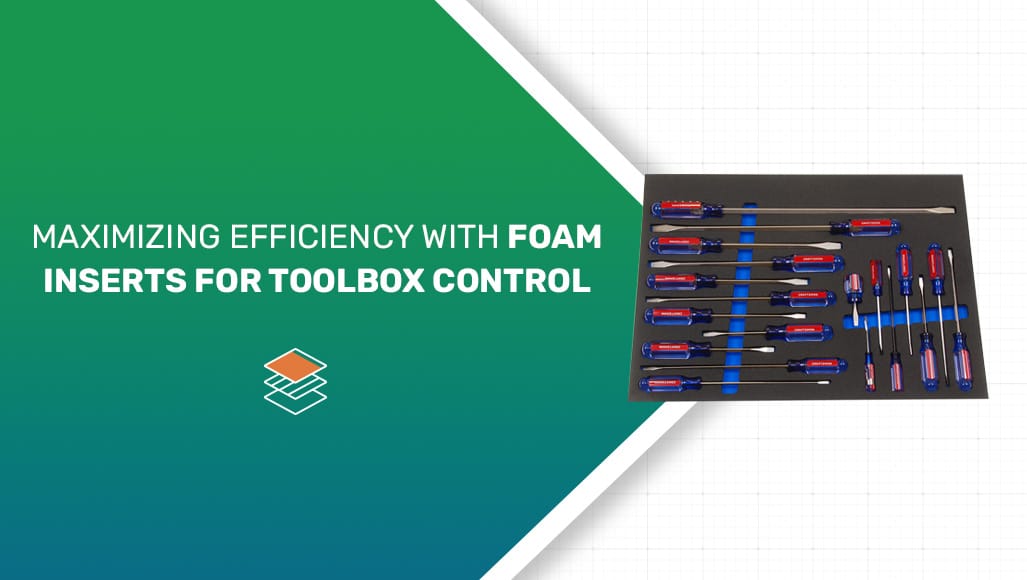
Maximizing Efficiency with Foam Inserts for Toolbox Control
Key Takeaways
- Prevent catastrophic risk and lost time by organizing toolboxes, as unorganized tools are a primary source of Foreign Object Debris (FOD) and cause significant “productivity collapse” from technicians searching for items.
- Achieve instant accountability using two-tone foam inserts, or “shadow-boarding,” which is a 5S principle that makes a missing tool’s brightly colored “shadow” immediately and unmistakably visible.
- Insist on the right material; Cross-Linked Polyethylene (XLPE) is the professional, closed-cell standard that resists oils and chemicals, unlike “pick-and-pluck” open-cell foam which absorbs contaminants like a sponge and degrades.
For professionals in demanding industrial, aerospace, and military environments, a tool chest is more than a storage box—it is a critical component of safety and operational readiness. You have likely invested in high-quality tool chests, but the efficiency and safety of your workflow are ultimately decided by what’s inside. Standard, unorganized drawers not only stall productivity but also introduce significant risks. Custom foam inserts for toolbox control are the definitive engineering solution, transforming chaotic drawers into high-efficiency, accountable assets.
The High Cost of Chaos: FOD and Wasted Hours
An unorganized tool chest is not just inefficient; it is an “active and persistent source of catastrophic risk”. In high-consequence industries, this risk has a formal name: Foreign Object Debris (FOD).
- The FOD Threat: FOD is any object that is not where it is supposed to be and has the potential to cause damage. While many think of external debris, the “most preventable, and often most insidious” hazards are those generated internally during maintenance—specifically, lost tools. Documented aviation incidents include screwdrivers lodged in engines and torches jamming landing gear. The financial impact is staggering, with estimates in the aerospace industry alone reaching $4 billion per year.
- The Productivity Drain: Beyond catastrophic failure, poor tool control results in a daily “productivity collapse”. Studies show technicians can spend a significant portion of their day simply searching for the right tool. In a defense context, this “delayed maintenance” directly reduces the “operational availability of weapon systems”. Effective foam toolbox organizers eliminate this search time, turning wasted hours into productive work.
From Chaos to Control: The Power of 5S Shadow-Boarding
The solution to this chaos is a core principle of Lean Manufacturing: 5S. Specifically, custom tool foam inserts are the most effective physical manifestation of Seiton (Set in Order), defined by the motto, “A place for everything and everything in its place”.
This system, known as shadow-boarding, uses high-contrast, two-tone foam to create a precise pocket for every tool. When a tool is removed, the bright, contrasting color of the bottom layer is exposed. This creates an unambiguous visual “shadow” that:
- Makes it “instantly noticeable” when a tool is missing.
- Forces immediate accountability at the point of use.
- Makes inventory audits and pre-closure checks instantaneous.
These foam drawer inserts are not just organizers; they are a fundamental safety and quality control system.
Engineering the Perfect Fit: A Deep Dive into Custom Tool Foam
A truly effective tool box insert is an engineered product. For a technical audience, it’s critical to understand that the material, fabrication, and design are all non-negotiable components of a successful system.
Material Matters: Why XLPE is the Professional Standard
The most common failure point in tool control is choosing the wrong material. Low-cost, “pick-and-pluck” foam is an open-cell foam, making it entirely unsuitable for professional use.
- Open-Cell Failures: This foam “can act like a sponge”, readily absorbing water, oils, solvents, and other contaminants. This leads to material degradation, promotes mildew, and can transfer corrosive agents back to your tools. Its structural integrity is also “weak” from the start.
- The Closed-Cell Solution: Closed-cell foam is the “only viable long-term investment”. Its sealed, non-porous structure “resists water and chemicals” and will not absorb contaminants.
- The Superior Choice: XLPE: Within this category, Cross-Linked Polyethylene (XLPE) is the high-performance choice. Its molecules are chemically bonded to form a “robust molecular network”. This makes it “remarkably robust and stiff”, “highly resistant” to industrial chemicals and oils, and completely waterproof. This is the ideal rigid foam inlay tool material for protecting valuable assets.
We take a deeper look at the properties of this industrial workhorse in our [Material Matters: Why XLPE Foam is the Industrial Workforce] blog post.
Precision in Practice: How Your Insert is Made
The material’s benefits are only realized through precision fabrication. How the pocket is cut is just as important as the foam itself.
- Waterjet Cutting: This is the gold standard for layered, two-tone foam tool inserts. The process uses a high-pressure jet of pure water to cut the foam. Critically, it is a “cold cutting process”. This means there is zero heat generation, no risk of melting, no warping, and no hazardous fumes. It produces exceptionally “clean, burr-free edges”.
- CNC Routing: This method uses a rotating bit to mill the foam. While waterjets are perfect for cutting through layers, CNC routing has a unique advantage: it can create pockets of “several different depths” within a single, solid block of foam.
- Laser Cutting: This thermal process is fundamentally unsuitable for thick tool foams like XLPE. The heat “melts” the foam, creates a “heat-affected zone” (HAZ), and produces “potentially hazardous vapors”.
Smart Design: Beyond Just a Pocket
The final element is intelligent, ergonomic design. This is what separates a professional, custom-fit insert from a frustrating one.
- Logical Layout: Tools should be grouped by function and flow, with the most frequently used items placed for easiest access.
- The “Finger Lift”: A critical, often-overlooked feature is the “finger lift” or “finger pull”. These are small, semi-circular cutouts added next to a tool to create space “to get a fingertip underneath for easy retrieval”. This minor detail makes a “massive difference” in daily usability. Without it, a frustrated technician may use another tool (like a screwdriver) to pry a stuck tool free, destroying the precision foam pocket in the process.
Upgrade Your Control with American Foam Products
Your high-value tools and critical workflows are non-negotiable. Don’t compromise them with low-cost, low-performance “pick-and-pluck” foam that will absorb contaminants and degrade over time.
A custom-fabricated tool chest insert from American Foam Products is an engineered solution. By using superior materials like XLPE, precision fabrication like waterjet cutting, and intelligent ergonomic design, we create custom tool foam inserts that provide true, long-term value. You get immediate gains in efficiency, unparalleled asset protection, and the critical, at-a-glance accountability required to eliminate FOD risk.
Don’t let your tools become a liability. Contact the engineering team at American Foam Products today to discuss your project and design the perfect foam inserts for toolbox control.