(440) 352-3434
Blog

Convoluted Foam: A Guide to Packing Applications
Key Takeaways
- Convoluted foam is a highly effective, low-cost solution for organizing items in case lids and providing non-abrasive surface protection to prevent scratches on lightweight, delicate items.
- Its most critical failure point is that it only cushions, it does not immobilize parts, which allows items to shift during transit and potentially suffer impact damage against the case walls.
- Standard polyurethane convoluted foam is “open-cell” (like a sponge), meaning it readily absorbs moisture and is fundamentally unsuited for humid environments or long-term storage, as it is prone to chemical breakdown (hydrolysis).
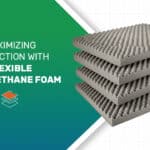
Convoluted foam, widely recognized as packing egg crate foam, is one of the most common and economical solutions for general-purpose cushioning. For engineers, product managers, and procurement specialists, the challenge lies in knowing when this versatile material is the right choice, and when it represents a critical point of failure.
While ideal for applications like case lid organization or separating stacked, lightweight items, convoluted foam does not provide the same high-level shock isolation as a precision-cut, custom-engineered insert. Its effectiveness is entirely dependent on its material composition, density, and application.
This guide provides a technical breakdown of convoluted foam, detailing its optimal uses, its critical limitations, and the key specifications to analyze before you buy.
What is Convoluted Foam (And Why Is It So Economical?)
The “egg crate” shape of convoluted foam is not molded; it’s the result of a highly efficient manufacturing process called “convoluting”.
In this process, a thick, solid block of foam is fed through specialized rollers that distort the material as it’s cut by a high-tension bandsaw. A single cut in a wave pattern produces two interlocking convoluted foam sheets from the original piece.
The primary benefit of this method is its “high-yield, low-waste” nature. This 2-for-1 material yield with “extremely little waste” is what makes convoluted foam an “inexpensive” and “economical” solution for general-purpose applications.
The Right Applications: When to Use Convoluted Foam
Convoluted foam is an excellent, cost-effective tool when used for the specific, low-level cushioning tasks it was designed for.
- Case Lid Organization: This is its most common and effective use. Placed in the lid of a hard case, the “wavy… pattern” presses down on items in the case base, “spreads pressure evenly”, and keeps multiple items snug in their compartments.
- Separators for Stacked Items: When “sandwiching” delicate items like plates or glass, the “interlocking and nonabrasive foam fingers” gently cradle the items, preventing them from shifting and making contact.
- Surface Protection (Scratch Prevention): The soft, open-cell polyurethane typically used for convoluted foam is non-abrasive. This makes it an excellent choice for protecting “Class-A” surfaces, painted items, or delicate electronics from “scratches or scuffs” during transit.
- Basic Shock Absorption (Low-Fragility): For items that are not highly fragile, convoluted foam provides a cost-effective layer of protection. The peaks and valleys “absorb shocks” and are suitable for lightweight items that only need a general buffer against rough handling.
Critical Limitations: When Convoluted Foam Fails
The failures of convoluted foam occur when it’s asked to do a job it wasn’t designed for: precision immobilization, heavy-duty support, or environmental protection.
Limitation 1: Part Shifting
This is the foam’s most critical failure point. Convoluted foam cushions; a custom-engineered insert immobilizes. With convoluted foam, the “part has the potential to shift during transit”. This internal movement is a “major cause of damage”, as the item can impact the case walls, rendering the cushioning useless. A custom-cut insert eliminates this movement entirely.
Limitation 2: The “Pressure Point Paradox”
Convoluted foam does not distribute pressure evenly on irregularly shaped items. Because the “convolute is the same height everywhere, added stress could be placed on parts which are taller while not enough pressure given to lower parts”. During an impact, all forces are concentrated on these few tall contact points (like a camera lens or a protruding knob), which can lead to fractures. A custom insert avoids this by supporting the entire item at its strongest points.
Limitation 3: Heavy Items
Standard convoluted foam is made from soft polyurethane. Heavy components will crush the foam’s “peaks,” eliminating its cushioning properties and causing the item to “bottom out” against the container surface. Heavy-duty applications mandate the use of rigid, high-density polyethylene foam.
Limitation 4: Material Degradation (The Hidden Risk)
Standard convoluted foam is typically made of open-cell polyurethane. This “sponge-like” structure is a critical, often-overlooked liability.
- It acts like a sponge: Open-cell foam “absorbs” moisture and “cannot resist liquid water or water vapor”.
- It degrades: This makes it highly susceptible to “hydrolysis” (a chemical breakdown from water) and “fungal attack,” especially in humid atmospheres.
- It’s unsuitable for long-term use: This material is “fundamentally unsuited” for applications in humid environments or for long-term storage.
Technical Specifications: How to Buy Convoluted Foam
When you buy convoluted foam, the shape is the last thing to consider. The “primary specification decision” must be its material and technical properties.
1. Material: Polyurethane (PU) vs. Polyethylene (PE)
The base polymer dictates performance.
- Polyurethane (PU) Foam: This is the default for convoluted foam. It’s a soft, open-cell, “sponge-like” material. It’s excellent for cushioning lightweight, delicate items. Its key weakness is poor moisture resistance.
- Polyethylene (PE) Foam: This is a rigid, dense, closed-cell foam. Its sealed-cell structure makes it a “vapor barrier” that is “highly resistant to moisture”. It is the superior choice for shock isolation for heavy equipment and any application in moisture-rich environments.
2. Foam Density (PCF)
This is the most critical specification for quality and durability. It’s a measurement of mass per unit volume (Pounds per Cubic Foot, or PCF).
Crucial Misconception: A widespread and costly error is assuming density equals firmness. It does not. You can have a high-density (durable) foam that is very soft, and a low-density (non-durable) foam that is firm.
Density is the single best indicator of durability. The Polyurethane Foam Association states, “the higher the polymer density, the better the foam will retain its original properties”. A cheap, low-density foam (e.g., 1.2 PCF) is “fair quality” and “prone to breaking down more quickly,” leading to higher long-term costs from product damage.
3. ESD Protection (For Electronics)
For electronics, using the correct Electrostatic Discharge (ESD) foam is non-negotiable. A common and costly procurement error is specifying “Anti-Static” (pink) foam, assuming it protects electronics.
- Anti-Static (Pink) Foam: Does not shield from external static. It only prevents static from being built up by friction. Items in pink foam must also be placed in a static-shielding bag. Its anti-static properties are also temporary and “humidity dependent”.
- Conductive / Dissipative (Black) Foam: These foams are “volume-conductive” (carbon-impregnated) and offer “permanent” ESD protection. They are designed to create a “Faraday cage” effect, providing true, reusable shielding.
Convoluted foam is available in all ESD variants, but it is critical to specify the correct one for your application.
Conclusion: The Right Protection for the Right Application
The choice between convoluted foam and a precision-cut insert is a matter of correct application. Convoluted foam is an excellent, low-cost solution for applications where its weaknesses—part shifting, uneven pressure points, and moisture absorption—are irrelevant.
For any high-value, heavy, irregularly-shaped, or fragile item (typically those with a G-Factor below 40 G’s), a custom-engineered insert is a mandatory investment. The cost of one single product failure in transit will almost certainly exceed the cost of investing in a precision-engineered solution.
Don’t guess which solution is “good enough.” The experts at American Foam Products can analyze your product’s weight, fragility, and environmental constraints to specify the right material, at the right density, for the right application. Whether that’s a cost-effective convoluted foam sheet or a precision-engineered, full-custom insert, we will design the solution that provides maximum protection and the lowest total cost of ownership.
Contact our design and engineering team today to discuss your project.